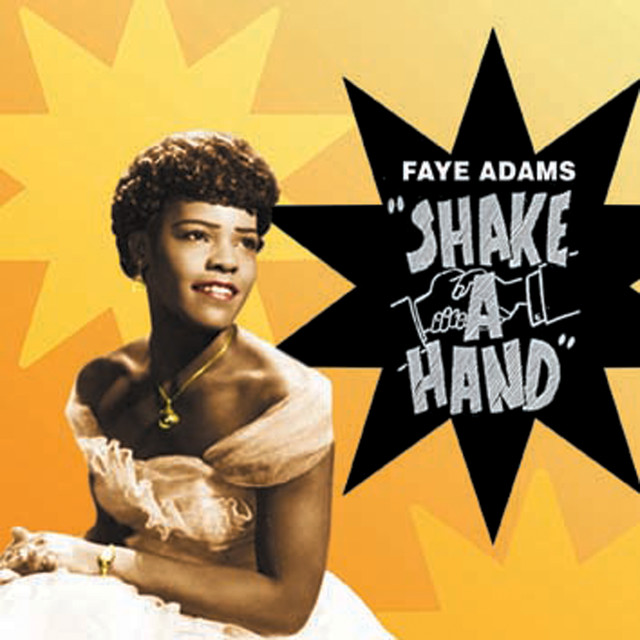
I was listening to some older music in my collection recently — some fine old R&B and soul. One of the songs that turned up is one I’ve heard at least a million times (no, I haven’t really counted) since its 1953 release — “Shake A Hand” by Faye Adams.
Even though it’s been covered by everyone from Jackie Wilson to Tina Turner to Little Richard to Elvis Presley, Adams’ version is the one I find the most moving, powered by Adams’ soaring voice and gospel roots.
The song was a big hit. It topped the R&B charts and held that spot for a couple months, until it was replaced by the musically similar follow-up, “I’ll Be True.” Together they sold almost two million copies. Adams’ third single, “Every Day,” didn’t do much, but she returned to the number one spot in mid-1954 with “Hurts Me to My Heart.”
So I thought that perhaps it would be a good idea to revisit Faye Adams, born Fanny Tuell in 1923, and recommend her music.
Adams had an especially soulful quality on some of her recordings, probably a product of her gospel upbringing. She was the daughter of David Tuell, a gospel singer and one of the key figures behind the Church Of God In Christ movement that would later contribute performers such as Billy Preston and Edwin Hawkins. At the age of five, Adams joined her siblings to sing spirituals as the Tuell Sisters. After marrying her future manager Tommy Scruggs in 1942, Tuell shifted toward secular music.
Under her married name, Faye Scruggs, she became a regular performer in New York nightclubs in the late 1940s and early 1950s. While performing in Atlanta, she was discovered by the singer Ruth Brown, who won her an audition with the bandleader Joe Morris of Atlantic Records. Morris changed Scruggs’s name to Faye Adams, and signed her to Herald Records. Her first release was Morris’s song “Shake a Hand.”
Adams’ vocals remind me of Brown and LaVern Baker, two of the best R&B singers of their day — or even since. All of them seemed to be bridging the gap between R&B styles and what was about to be known as rock ‘n’ roll. They also had a great deal of what would soon come to be called “soul.”
Indeed, according to the Acoustic Music organization, the “first clear evidence of soul music shows up with The “5” Royales, an ex-gospel group that turned to R&B and in Faye Adams, whose “Shake A Hand” becomes an R&B standard.”
Following her hit singles, she left the Morris band and was billed as “Atomic Adams.” And you can find a fine compilation of 40 of her songs on a release called “The Very Best of Atomic Adams.” By the late 1950s, her career diminished, although she continued to record into the early ’60s.
By 1963 Adams had retired from pop music. She remarried in 1968 and, as Fannie Jones, returned to gospel music and family life in New Jersey. In the 1970s, she was credited as co-writer, with her husband Clarence E. Jones, of several gospel and secular songs, and released a single, “Sinner Man”, on Savoy Records.
There isn’t a lot of information about her on the interwebs, where this brief history has been found, and I couldn’t even find anything to indicate when she died.
But her music lives, and it’s worth a listen, as she contributed a powerful vocal style that sat astride the musical bridge between R&B, soul and rock.
Her singles shift between those styles, usually in front of what sounds like a full band, sometimes crisp with sultry sax solos, and sometimes soaring ballads.
Adams didn’t become as famous as Brown or Baker, both powerful and popular singer from that era, but her big voice — almost a blues shouter at times — and recordings reflect similar qualities. And on more soulful material, it’s easy to hear the influence of the gospel music that sparked her early years, and to which she eventually returned.
Give her music a hearing. It deserves to remain part of our musical story.
Here are a couple YouTube videos to get you started.
 Blues Roadhouse