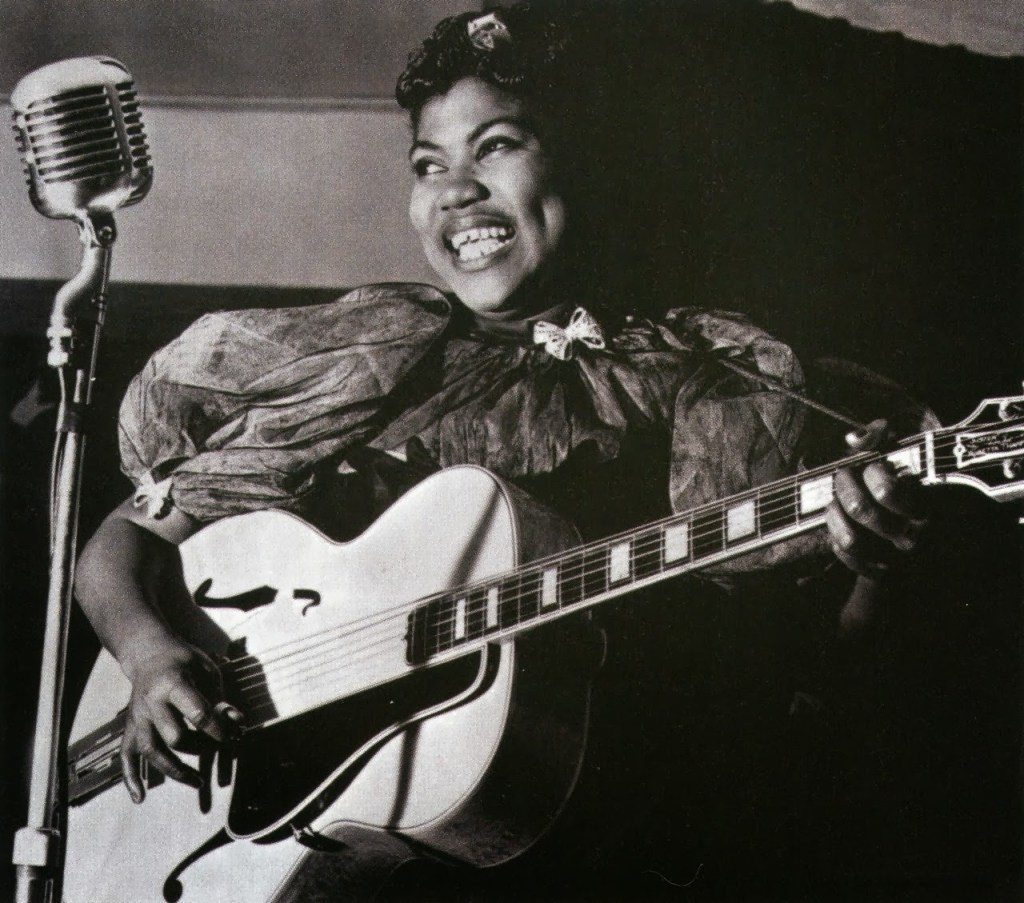
The short answer to that intriguing question is: Most likely.
Her groundbreaking and influential music — a heavy dose of hard-driving electric guitar backing both spiritual and secular performances with her powerful vocals — has too often been lost in the musical wilderness preceding the 1950’s explosion of the music that came to be called rock ‘n’ roll.
Born in Cotton Plant, Ark., in 1915, as Rosetta Nubin, she was playing guitar at age 6, and attended church conventions with her mother, Katie Bell Nubin. They moved to Chicago, where her mother preached, and Rosetta married another preacher, Thomas Tharpe. By 1938, they moved to New York City, where Tharpe got a spot at The Cotton Club.
She worked with Lucky Millender’s Orchestra, performing and recording both gospel and secular songs such as “Four Or Five Times.” A few years later, Tharpe and pianist Sammy Price recorded her biggest hit, “Strange Things Happening Every Day.”
Tharpe recorded her first four sides in 1938 during a session that included her first hit, “Rock Me,” along with “That’s All.” Four years later, Billboard magazine praised her for “the rock-and-roll spiritual singing” in her re-recording of “Rock Me” with the Lucky Millender Orchestra. Tharpe also recorded with the great boogie-woogie pianist Albert Ammons. And boogie-woogie piano itself laid claim to forming the early underpinnings of rock ‘n’ roll.
After that auspicious beginning, Tharpe’s career lasted well into the 1950s, influencing countless early guitar rockers and many others.
Chuck Berry once said his entire career was “one long Sister Rosetta Tharpe impersonation.” On stage, she did an early version of Berry’s duckwalk. Little Richard called her his greatest influence and Tharpe was the first to put him on stage. Little Walter Jacobs, the legendary blues harp player, credited his music to one of Tharpe’s biggest hits, “This Train.”
Tharpe finally made it into the Rock And Roll Hall of Fame in 2018, but despite that honor, and despite her massive body of work, her talent and influence are not well known today.
I’d like to help remedy that with the Tharpe documentary that follows. It’s about an hour long, but it’s worth it to sample her long and influential career and help to restore her place in music history. Below that are two early recordings that illustrate her style. Enjoy.
“Up Above My Head”
“This Train”
 Blues Roadhouse