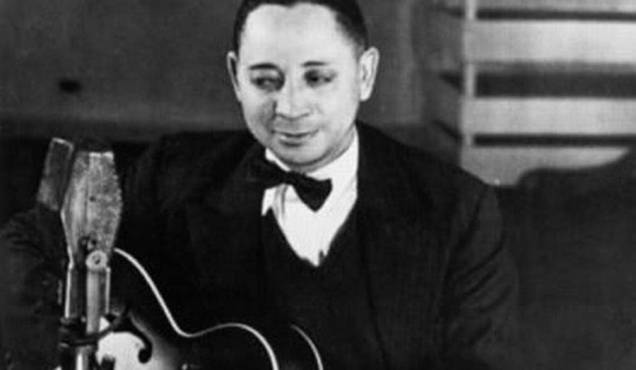
Let’s talk about Tampa Red.
This prolific, innovative and influential bluesman had a career that began as a Chicago street musician around 1925 and lasted more than three decades.
Because he was so innovative and influential, Tampa Red deserves much more general recognition than he usually gets, even though his name might not be a household word, like some of his contemporaries.
Although Red is commonly referred to as Hudson Whittaker, he was born Hudson Woodbridge in Smithville, Ga., sometime between 1900 and 1908, according to his own conflicting claims, although the date of birth on his death certificate is Jan. 8, 1904. His parents, John and Elizabeth Woodbridge, died when he was a child, and he moved to Tampa, Fla., to be raised by his aunt and grandmother and where he adopted their family name, Whittaker. By the time he moved to Chicago, Tampa had become part of his name, as had Red, usually attributed to his light skin color.
And so, Tampa Red was born.
He is said to have taken after his older brother, Eddie, who played the guitar around the Tampa area, and he was especially taken with an old street musician called Piccolo Pete, who first taught him to play blues licks on the guitar. Red also picked up on early recordings of female blues singers. He told interviewer Martin Williams “That [1920] record of “Crazy Blues” by Mamie Smith, it was one of the first blues records ever made. I said to myself, ‘I don’t know any music, but I can play that’.”[
And play he did.
In 1928, Red became the first black musician to play a National steel-bodied resonator guitar, the loudest and showiest guitar available before amplification, acquiring one in the first year in which they were available. This allowed him to develop his proficiency on bottleneck style, playing single-string runs instead of block chords, the forerunner of later blues and rock guitar solo work.
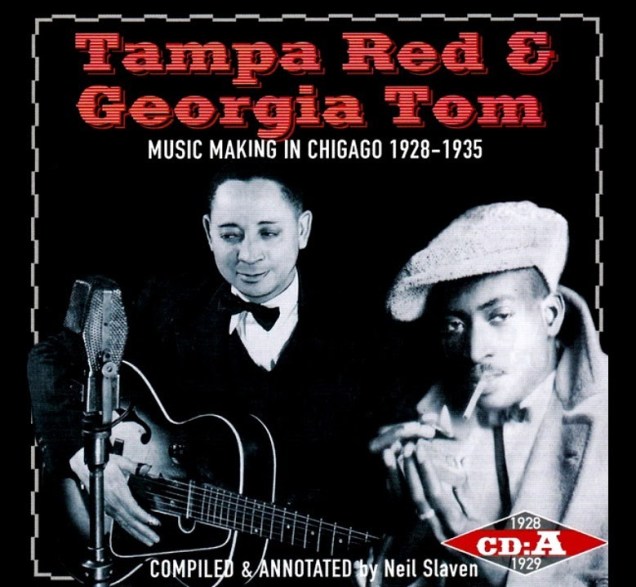
While in Chicago, he met Thomas A. Dorsey, also known as Georgia Tom, who was an accomplished pianist, composer and arranger who got Red his first Paramount Records session in 1928. Dorsey recorded with Red for a few years, performing rollicking little tunes known as hokum music, sometimes called the dirty blues, which favored humorous and risqué tunes like “It’s Tight Like That,” recorded in 1928. Dorsey left secular music for the church in 1932 to become a legendary gospel composer and often was called the father of modern gospel music. But that’s another story.
Red soon became known as the “guitar wizard” — the title of a later package of recordings on the Bluebird label. Bluebird was a subsidiary of RCA Victor, known for its blues, jazz and swing in the 1930s and 1940s. Red formed the Chicago Five, a group of session musicians who created what became known as the Bluebird sound, a precursor of small-group jump blues, R&B and rock ‘n’ roll. But that’s also another story.
Red was a friend of many of his contemporaries, including Big Bill Broonzy and Big Maceo Merriweather, with whom he also recorded. His Chicago home was a center for the blues community, providing rehearsal space, bookings, and lodgings for musicians who arrived in Chicago from the Mississippi Delta.
By the 1940s, Red was playing an electric guitar. In 1942, his “Let Me Play with Your Poodle”, was a number 4 hit on Billboard’s new “Harlem Hit Parade”, a forerunner of the R&B chart. His 1949 recording “When Things Go Wrong with You (It Hurts Me Too)” which was really early R&B, was covered by Elmore James, among others.
Red was one of the most prolific blues recording artists of his era. It has been estimated that he recorded 335 songs, with 251 recorded between 1928 and 1942, making him the blues artist with the most recordings during that period. He had four singles that placed in the R&B top ten between 1942 and 1951. Among his best-known recordings are “Anna Lou Blues”, “Black Angel Blues”, “Crying Won’t Help You”, “It Hurts Me Too”, and “Love Her with a Feeling”.
Tampa Red’s influence extended beyond his lifetime. His innovative guitar playing and pioneering use of the electric guitar laid the groundwork for later blues artists like Muddy Waters, B.B. King, and Jimmy Reed. As one of the first blues musicians to incorporate jazz elements into his work, he also had a lasting impact on the crossover between blues and jazz, influencing musicians in both genres. In 1959, Tampa Red was inducted into the Blues Hall of Fame. If you listen to some of his later recordings, you can hear the beginnings of what would much later be called rock ‘n’ roll. For example, listen to the pounding rhythms of “Evalina,” with Big Walter Horton (see sample below).
Like many early bluesmen, Red’s later life was filled with loss and pain. His wife, Frances died in 1953, and the loss began his decline into alcoholism. When Jim O’Neal, co-founded of Living Blues Magazine, discovered him living in Chicago in 1974, Red was reportedly in a much worse shape than in his earlier years. By January 1975, he was at a state hospital in Chicago. Red lived out his final years in Central Nursing Home, where he died from a heart attack on March 19, 1981. Red was 77.
The next time you think of great early blues artists, remember Hudson “Tampa Red” Whittaker. His legacy deserves much wider appreciation.
Note: I’ve culled most of this post from a variety of what I believe are reliable internet sources, adding my own thoughts.
Here’s a very small selection of Tampa Red’s music. You can find much more on YouTube and streaming services. It’ll be worth your time.
 Blues Roadhouse