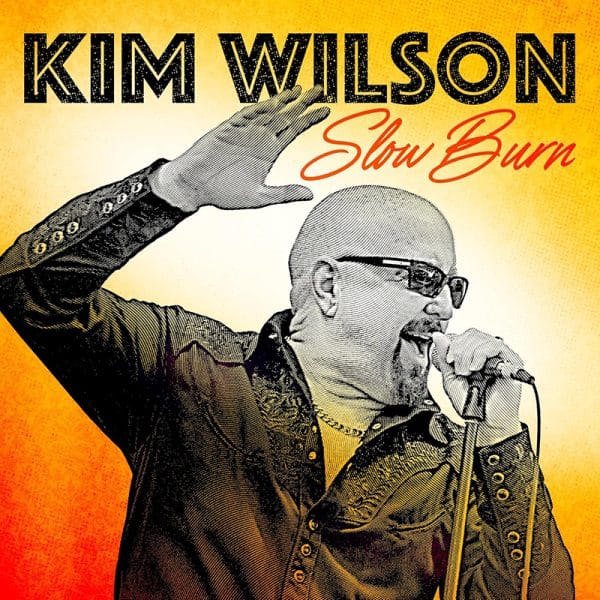
Roadhouse Album Review: Kim Wilson sparks “Slow Burn” with fiery harp and torchy vocals

Kim Wilson — “Slow Burn” — M.C. Records

For a half-century and change, Kim Wilson’s harp and vocals have led The Fabulous Thunderbirds, the rugged blues band he co-founded in Austin, Texas, in 1974, that supercharged blues music with Wilson’s soaring harp and Jimmie Vaughan on guitar.

He’s the only original member of the T-Birds still with the band, with Wilson now sometimes stepping out on his own.

“Slow Burn” is his latest solo effort. The songs are taken from two earlier sessions in 2014 and 2020 that featured three outstanding musicians who have since died: drummer Richard Innes, piano player Barrelhouse Chuck, and bassist Larry Taylor.

Eight of the twelve tracks here are classic blues from legendary bluesmen, re-imagined and channeled through Wilson’s prodigious harp and vocals that are more than tuff-enuff for the task. The four originals, especially two instrumentals, show off Wilson’s own powerful classic stylings.

Everything begins with a romp?? through Little Milton’s “I’m Trying,” with a layer of horns endorsing Wilson’s ever-so-smooth vocal. Wilson’s “Leaving You on My Mind” adds gut-bucket attitude to a down-home trio of harp, guitar and drums.

Wilson gives B.B. King’s “Sweet Little Angel” a convincing vocal workout, with Bob Welsh adding just-right guitar, and Barrelhouse Chuck on piano. “Boogie in E” is Wilson’s first instrumental, a flashy bit of harmonica virtuosity. “Howlin’ For My Darlin’” is appropriately down and dirty Howlin’ Wolf (Chester Burnett), followed the harp wizardry and vocal richness of “Keep Our Business To Yourself” Alex Miller (who performed as Sonny Boy Williamson II).

Wilson reaches deep into the blues for the first of two songs from Robert Nighthawk, who doesn’t often get the recognition he deserves. The first is the swampy “The Time Has Come” that speaks eloquently of its deep blues roots. Wilson’s “Lowdown Woman” shuffles along before Magic Sam’s “Easy Baby” stirs its simmering blues into the mix. “Gotta Have A Horse” is the second Wilson instrumental, another relentless harmonica blowout. Wilson aces another Nighthawk gem, a rollicking “Kansas City” (from 1951, not the 1952 Leiber-Stoller creation).

The closer is nine-minute tour-de-force version of Otis Rush’s classic “So Many Roads,” with a gorgeous two-minute harp intro followed by Wilson’s aching vocal, and more harp woven elegantly throughout.

Wilson, talking about making this album, says:
“The tracks on this album are very special because several of the songs include some of the last
performances in the studio by three great blues giants, Richard Innes, Larry Taylor, and
Barrelhouse Chuck. Basically, everything was recorded the same way they did it in the old days.
Some great blues for you fans, and I hope you enjoy it as much as we did making it.”

“Slow Burn” is a great title for this session of fiery blues, torrid harp work and soulful, torchy vocals. Kim Wilson has added this music to his tough, hard-working blues legacy that thankfully shows no sign of slowing down.


Here’s a Kim Wilson interview with Blues Blast Magazine


“Leaving You On My Mind” from the album:

Just for fun, here’s the Robert Nighthawk version of “Kansas City”:

Tracklist & credits:
Track 1 – I’m Trying (Milton Campbell)
Vocals/Harmonica: Kim Wilson
Guitar: Billy Flynn
Piano: Barrelhouse Chuck
Drums: Marty Dodson
Horns: Johnny Viau

Track 2 – Leaving You On My Mind (Kim Wilson)
Vocals/Harmonica: Kim Wilson
Guitar: Billy Flynn
Drums: Malachi Johnson

Track 3 – Sweet Little Angel (B.B. King)
Vocals/Harmonica: Kim Wilson
Guitar: Bob Welsh
Piano: Barrelhouse Chuck
Bass: Troy Sandow
Drums: Marty Dodson

Track 4 – Boogie in E (Kim Wilson)
Vocals/Harmonica: Kim Wilson
Guitar: Billy Flynn
Bass: Troy Sandow
Drums: Malachi Johnson

Track 5 – Howlin’ For My Darlin’ (Chester Burnett)
Vocals/Harmonica: Kim Wilson
Guitar: Bob Welsh
Piano: Barrelhouse Chuck
Bass: Troy Sandow
Drums: Marty Dodson

Track 6 – Keep Our Business To Yourself (Sonny Boy Williamson II/Rice Miller)
Vocals/Harmonica: Kim Wilson
Guitar: Billy Flynn
Drums: Marty Dodson

Track 7 – The Time Has Come (Robert Nighthawk)
Vocals/Harmonica: Kim Wilson
Guitar: Bob Welsh
Piano: Barrelhouse Chuck
Bass: Troy Sandow
Drums: Marty Dodson

Track 8 – Lowdown Women (Kim Wilson)
Vocals/Harmonica: Kim Wilson
Guitar: Billy Flynn
Bass: Troy Sandow
Drums: Malachi Johnson

Track 9 – Easy Baby (Samuel Maghett)
Vocals/Harmonica: Kim Wilson
Guitar & Piano: Barrelhouse Chuck
Guitar: Billy Flynn
Bass: Troy Sandow
Drums: Malachi Johnson

Track 10 – Gotta Have A Horse (Kim Wilson)
Vocals/Harmonica: Kim Wilson
Guitar: Billy Flynn
Bass: Troy Sandow
Drums: Malachi Johnson

Track 11 – Kansas City (Robert Nighthawk)
Vocals/Harmonica: Kim Wilson
Guitar: Bob Welsh
Piano: Barrelhouse Chuck
Bass: Troy Sandow
Drums: Marty Dodson

Track 12 – So Many Roads (Otis Rush)
Vocals/Harmonica: Kim Wilson
Guitar: Billy Flynn
Bass: Troy Sandow
Drums: Malachi Johnson

Key contributors:
Nathan James – mixing, mastering, production, and performance.
Billy Flynn – guitar and bass on multiple tracks.
Troy Sandow – bass on several tracks.
Marty Dodson, Malachi Johnson, Richard Innes – drums across different sessions.
Barrelhouse Chuck, Bob Welsh, Johnny Viau – piano, guitar, and horns.
The Rhythm Scratchers (Wilson’s bandmates) are highlighted for their one-take quartet recordings.

Roadhouse Album Review: Sean McDonald shows no mercy for the blues with his debut, “Have Mercy”

Sean McDonald — “Have Mercy” — Little Village Foundation

Sean McDonald, just 23, is one of those young new artists, who, when you close your eyes, sounds like he’s been aging in a cask of blues for decades.

“Have Mercy” is McDonald’s first album, a modest collection of nine covers and originals that plays to his strengths as a singer, songwriter and guitarist.

But there’s nothing modest about his talents. A native of Augusta, Ga., McDonald sang in the church as a youngster and learned to play multiple instruments.

McDonald co-produced this sparkling session with Christoffer “Kid” Andersen at Andersen’s Greaseland U.S.A. Studio, with the outstanding studio musicians from the Little Village label who back McDonald with their usual excellence: Jim Pugh on keyboards, June Core on drums, bassist D’Quantae “Q” Johnson, saxmen Eric Spaulding and Jack Sanford, and trombonist Mike Rinta. The Morgan Brothers (formerly the Sons of the Soul Revivors) and Marcel Smith add eloquent backing vocals to the gospel tracks. Sometimes it just takes a Little Village to help make great music.

A rocking cover of Rudy Moore’s “My Soul” opens the album, with McDonald’s upbeat? ? vocal turn a spirited album preview. A pair of originals follows: The tastily R&B-flavored “Fakin’ It” features killer sax with a fierce guitar break; “Killing Me” finds McDonald reaching deep into a sexy slow blues, complete with sensuous sax.

“Rocking in the Same Old Boat” is a gorgeous slow blues recorded by Bobby “Blue” Bland in 1968, and McDonald’s smooth rendition dares to stand on its own. (The composer is credited as Deadric Malone, but that was the penname for influential Duke/Peacock records owner Don Deadric Robey, who often took the credit for songs written by his artists. The interwebs reveal that Vernon Elbert Morrison may have been a composer.)

“Shuffleboard Swing” is a rollicking instrumental that swings the blues behind McDonald’s blistering single-note guitar work. “Angel Baby” is McDonald’s fast and furious Little Richard-inspired rocker, complete with vocal scream and raunchy sax. McDonald testifies mightily with the gospel of “Don’t Let the Devil Ride,” an Oris Mays creation, with a fervent chorus from the Morgan Brothers and Marcel Smith.

The rousing “That’s All I Need” captures the rocking flavor of Ike Turner’s 1959 version complete with call-and-response backup singers. The closer is the elegant Henry Glover blues ballad, “Let’s Call It A Day,” with McDonald smooth as silk on the vocal, and tough as nails on his wicked guitar.

With “Have Mercy,” a youthful Sean McDonald emerges as a full-grown talent. His smart songwriting, rich vocals and stunning guitar all speak eloquently of his musical future, not to mention the future of the blues and our own listening pleasure.

Have mercy, indeed!


Here’s “Rocking in the Same Old Boat” from the album:

Tracklist:

  1. My Soul 3:20 (Rudy Moore)
  2. Fakin’ It 3:56 (S. McDonald)
  3. Killing Me 5:06 (S. McDonald)
  4. Rocking in the Same Old Boat 4:51 (Deadric Malone)
  5. Shuffleboard Swing 4:05 (S. McDonald)
  6. Angel Baby 3:00 (S. McDonald)
  7. Don’t Let the Devil Ride 5:14 (Oris Mays)
  8. That’s All I Need 3:10 (Ike Turner)
  9. Let’s Call It A Day 3:58 (Henry Glover)

Sean “Mack” McDonald – Vocals, guitar
The Morgan Brothers – Vocals
Marcel Smith – Vocals
Jim Pugh – Piano, organ
D’Quantae “Q” Johnson – Bass
June Core – Drums
Eric Spaulding – Tenor Sax
Jack Sanford – Bari Sax
Mike Rinta – Trombone (4)
Kid Andersen – Guitar (4)
Lisa Leuschner Andersen – Vocal (2)

Roadhouse Ramblings: Hank Ballard and the Midnighters put guitars – and raunch – into rock ‘n’ roll

Hank Ballard and the Midnighters have always been one of my favorite groups, ever since they caught my teenage hormones’ attention, ‘way back in the middle of the 20th century — the 1950s, to be precise.

Their “Greatest Hits” album, released in 1956 on the Federal label, was my first album purchase. I was already hooked on classic doo-wop and early R&B, thanks to Pittsburgh DJ, the Daddio of the Raddio, The Bossman — Porky Chedwick.

But the Midnighters aroused my teen blue genes from their musical slumber. Their furiously styled music was great for dancing, their lyrics magnificently raunchy, giving hope to teens everywhere that there might be, according to one account, “life below the waist,” despite much of the soporific pop from earlier years.

Ballard augmented the horns of more traditional R&B with guitars, driving the music hard behind soaring vocals. The band played a pivotal role in bridging the gap between traditional rhythm and blues and early rock and roll, turning out a series of hits in 1954. Those early sides included a set of deliciously salacious and unabashedly sexual recordings built around the “Annie” songs: “Work With Me Annie” (It sold more than a million copies despite being banned from many radio stations) and “Annie Had a Baby.” But even without that notoriety, the Midnighters created cutting edge R&B that bled into rock ‘n’ roll. Even their more sensitive ballads (“Teardrops on Your Letter,” “Rain Down Tears”) churned with emotion. Ballard would write “The Twist” in 1959, which was turned into a Chubby Checker hit by Dick Clark, earning Ballard royalties, if not fame.

The Midnighters’ eventually faded into the 1960s, and even though they continued to record, their R&B stylings became less relevant. I hadn’t played any of their music for years, and they were unlikely to be found on many modern streaming playlists.

Radio.

Then a few years ago, radio came back into my life.

I discovered WMNF, a public radio station in Tampa, Fla., and its three weekly hours of music that I loved – The Rhythm Revival, hosted by the Rev. Billy C. Wirtz (William Wirths) and Marvelous Marvin Boone (Marvin Boone). They play great old post-war blues, R&B, country and gospel, and displaying their encyclopedic musical knowledge, connect the dots between all those genres.

The Revival claims several groundbreaking artists as its “patron saints,” including Patsy Cline, Wynonie Harris, and much to my delight, Hank Ballard and the Midnighters. The inspiration for this post comes from the Revival’s recent birthday tribute to Ballard (born John Henry Kendricks on Nov. 18, 1927, in Detroit).

The early years of Ballard and the Midnighters’ were filled with much of the shape-shifting, name and personnel changing common to much of the industry. Here are some details of their illustrious career, shamelessly copied from Wikipedia:

In 1953, Ballard joined doo-wop group the Royals, which had previously been discovered by Johnny Otis and signed to Federal Records (a division of King Records), in Cincinnati. Ballard joined Henry Booth, Charles Sutton, Sonny Woods and Alonzo Tucker in the group, replacing previous singer Lawson Smith, who went on service in the Army.

The Royals released “Get It” which Ballard wrote (1953), an R&B song with possibly sexually oriented lyrics, which some radio stations refused to play, although it still made it to number 6 on the US Billboard R&B chart.

Hank Ballard and the Midnighters.

The group then changed its name to the Midnighters to avoid confusion with the “5” Royales. In 1954, Ballard wrote a song called “Work with Me, Annie” that was drawn from “Get It”. It became the Midnighters’ first major R&B hit, spending seven weeks at number 1 on the R&B chart and also selling well in mainstream markets, along with the answer songs “Annie Had a Baby” and “Annie’s Aunt Fannie”; all were banned by the FCC from radio airplay. Their third major hit was “Sexy Ways”, a song that cemented the band’s reputation as one of the most risqué groups of the time.

Between 1953 and 1962, the Midnighters had several hits on the U.S. pop and R&B charts. Their hits included the million-selling Billboard top 10 pop hits “Finger Poppin’ Time” (for which they received a 1961 Grammy Award nomination),[1] and “Let’s Go, Let’s Go, Let’s Go”. The Midnighters also had 13 top 10 R&B hits, including three that reached number 1. Their top 10 R&B hits included “Work with Me, Annie”, “It’s Love Baby (24 Hours a Day)”, “Annie Had a Baby”, “The Hoochi Coochi Coo”, “Teardrops on Your Letter”, “Get It”, “The Float” and “Nothing but Good”.

They received the Rhythm and Blues Foundation’s prestigious Pioneer Award in 1992, and were inducted into the Vocal Group Hall of Fame in 1999. The Midnighters are also noted for achieving a music industry milestone in 1960, by becoming the first group in history to place 3 singles on the Billboard Hot 100 at the same time. The group’s lead singer, Hank Ballard, was inducted into the Rock and Roll Hall of Fame in 1990. The Midnighters as a group were inducted into the Rock and Roll Hall of Fame on April 14, 2012.

Hank Ballard and the Midnighters deserve a unique place in American musical history. They created a sound that would shake rhythm and blues, rattle its bones, and roll it into the primitive days of rock ‘n’ roll.

Best of all, the Midnighters still sound damn fine!


Here are three songs that helped define Hank Ballard and the Midnighters: