Roadhouse Ramblings: James Carr, the greatest soul man you’ve probably never heard — but you really, really should

James Carr

I heard James Carr sing for the first time a few nights ago on the radio. Well, to be accurate, I wasn’t listening to the actual radio, but to an archived radio show, on my computer, played through a good speaker system.

To be even more accurate, I was listening to a replay of my favorite radio show (actually, the only radio show I listen to), the Rhythm Revival on public radio station WMNF in Tampa, Fla. It’s hosted by the Rev. Billy C. Wirtz and Marvelous Marvin Boone, whose combined musical knowledge is dazzlingly encyclopedic and thoroughly enjoyable.

But I digress.

As part of their regular Friday afternoon gig showcasing great old music that most people have probably never heard, they played the powerfully soulful 1967 song “Pouring Water on a Drowning Man” by Carr, who died in 2001 at the age of 58, after a relatively brief career creating this gorgeous music.

After that tantalizing introduction, I found more information on Carr’s career and more of his music in that magic box called the internet. For starters, you can still buy (or stream) “The Complete Goldwax Singles of James Carr,” the 28 soul-filled songs he recorded for the now-defunct Goldwax label in the 1960s, on Kent Records, which is now owned by Ace Records in England. Goldwax, by the way, seemed to be tied to the fate of Carr, and it folded in 1969, at the end of Carr’s run of powerful single recordings.

Naturally, I listened. I’ve heard some great soul men in my time, but Carr’s gritty, passionate vocals grabbed me at that purely instinctual level where the artist rips the music from the bottomless depths of his tortured soul and pours it into yours. Yes, it’s that good.

Most of these songs are slow and steamy, overflowing with heartache and desperation, each one delivered as intensely as though it could be his last. Even the uptempo numbers are furiously passionate. I don’t know who the musicians are all on these recordings, but they groove in complete sympathy with the power of Carr’s rich voice, which he brought with him from his youthful days singing in his pastor father’s Baptist church choir. He’s another of the many great soul singers who crossed over from the sacred to the secular with their music, bringing with them it’s fervor, if not its message.

In fact, Carr was a member of the gospel group The Redemption Harmonizers (along with another potential great in O.V. Wright) that drew the attention of Roosevelt Jamison, a singer/songwriter who would become James’ manager.

The Goldwax label is where Carr recorded the music the rivaled that of Wright and Otis Redding with its emotional intensity. After his first few sides, he recorded what would become his signature song in 1966, “The Dark End of the Street.” It’s been covered by a variety of artists, but none really match the sheer soul power of Carr’s version. And the lyrics themselves were appropriately dark, matching his deep soul interpretation: “At the dark end of the street/That’s where we always meet/Hiding in shadows where we don’t belong/Living in darkness to hide our wrongs.

Sadly, Carr was troubled with mental health problems — some reports indicate bipolar issues — and his career never really flourished, despite comeback attempts in the late ’70s and the ’90s.

However, his recorded legacy, especially on the Goldwax sides, is quite simply, magnificent. The sheer power of his voice is magical.

Just when you thought you couldn’t reach any deeper into the heart of soul music, James Carr sweeps out of that primeval place where soul music lives and takes you there with him. You should make the trip.

Sweet, sweet soul music. There’s nothing quite like it.


Here’s an informative and interesting article on Carr’s life from the Soul Cellar web site.


Here’s an audio version of “Dark End of the Street,” followed by a much later live performance:

Roadhouse Album Review: Arlen Roth & Jerry Jemmott are indeed super and soulful on “Super Soul Session!”

Arlen Roth & Jerry Jemmott — “Super Soul Session!” — Blue Heart Records

The title of this splendid album is already a great description of its music — super and soulful. But I would add one word: smooooth.

This smooth, soulful music is the result of combining the talents of two sensational musicians from an era when soul music sweetened the land — guitarist Arlen Roth, the “Master of the Telecaster,” and bassist Jerry Jemmott, “The Groovemaster,” a member of the legendary R&B group, King Curtis & The Kingpins.

Both men lent their considerable talents to some of the biggest names in music in the late 1960s and ’70s. They include Paul Butterfield, Art Garfunkel, John Prine, Pete Seeger, the Bee Gees, Simon and Garfunkel, James Taylor and more (Roth), and Aretha Franklin and B.B. King (Jemmott, who is currently grooving with the Little Village people and Kid Anderson’s Greaseland studio.)

For this session they gathered keyboardists Bruce Katz and Alex Salzman, rhythm guitarist Tom Gage, drummer Chris Parker, the Uptown Horns and special guests Joe Louis Walker and African vocalist Mukamuri.

Then they added a selection of a few of their favorite songs, some of which they were instrumental in creating as session and touring musicians.

The result? This super smooooth soul session. The tracks are all classics, instantly recognizable as the soundtracks from many a life back in their days.

Mukamuri, a solid soul singer from Zimbabwe and based in Doylestown, Pa., and from whom we need to hear much more, reaches back in time and mood to open the set with “I’m Just a Mortal Man,” from Jerry Lawson of The Persuasions.

“(Sweet Sweet Baby) Since You’ve Been Gone” is the first of several pure instrumental tracks highlighting Roth and/or Jemmott. These selections make an unusual musical statement here, dispensing with familiar lyrics and cutting to their soulful essence. It’s a refreshing take, with Roth’s fluid guitar leading the way, ahead of a punchy horn section.

“Dancing In the Street,” another instrumental, follows with its rock steady groove dedicated to James Jamerson, one of the best of the bass players, complimented nicely by smooth slide guitar.

Joe Louis Walker takes us back to the B.B. King standard, “The Thrill is Gone;” Mukamuri returns with Lexie Roth on the soaring Jackie Wilson number, “(Your Love Keeps Lifting Me) Higher and Higher” and then an instrumental “Chain of Fools,” still gorgeous without Aretha. Walker comes back with a vengeance on “Shake,” one of last songs Sam Cooke recorded before his death, and Mukamuri breathes new life into Dobie Gray’s giant hit, “Drift Away.”

Roth shows up with his voice and his slide for a swampy version of the Rolling Stones’ “Down Home Girl,” by Artie Butler and Jerry Leiber (which is worth mentioning simply because Leiber’s name, usually with Mike Stoller’s, turns up on so much great music from that era).

Roth turns his guitar into the vocalist on a lively version of “The Weight,” and Mukamuri steps back in with a soulfully countrified version of “Good Time Charlie’s Got the Blues, with some lovely guitar work.

“Memphis Soul Stew” is a track from “King Curtis Live at Fillmore West,” with original Kingpin Jemmott back, introducing himself and the narrating the recipe for this simmering soul standard with Ronee Martin.

The session ends fittingly with a stirring instrumental version of “America the Beautiful” with Katz on piano and organ that revives the soul-drenched spirit of Ray Charles’ eloquent 1972 version.

This album offers a gorgeous take on some of the most memorable musical moments from the defining era of soul music. It’s fresh, it’s nostalgic — it’s great listening. Slip into it slowly late at night with some smooooth whiskey. It’s guaranteed to fill that hole in your… well, you know.


“I’m Just a Mortal Man”:

Roadhouse Album Review: Larry Taylor & family revive Chicago’s West Side in “Generations of Blues”

Larry Taylor & the Taylor Family — Generations of Blues: West Side Legacy — Nola Blue Records (June 16)

Larry Taylor has created the best kind of tribute band.

It’s the kind that involves the real deal, not imposters — in this case family members, carrying on a Chicago blues tradition.

The father, Eddie Taylor, was a fixture on Chicago’s West Side blues scene. His distinctive guitar work was a driving force behind the music of Jimmy Reed, Snooky Pryor, John Lee Hooker, Floyd Jones, Elmore James and more, until his death in 1985.

In 2015, Taylor’s son Larry, a singer and drummer, got his brothers and sisters together to create a tribute to their father and the West Side blues that nourished them. Since then, that album project grew to become a salute to the 100th anniversary of their father’s birth in 1923.

This tough, old-school session includes 13 songs performed by the Taylor family’s second and third generations: with five written by Eddie Taylor, one by Vera Taylor, four by Larry Taylor and three blues covers.  

It’s truly a blues family affair. And since that family is steeped in the deep tradition of Chicago’s West Side blues, it’s blues with a feeling, doubled down on by these rich family connections. The entire session breathes new life into the classically tough Eddie Taylor songbook and adds a pair of blues chestnuts for good measure.

Eddie Taylor Jr. plays guitar on nine tracks recorded before his death in 2019. Larry Taylor handles most of the vocals, Larry’s son, Lil’ Jet, raps on an adaptation of Bill Withers’ “Ain’t No Sunshine.” Sisters Brenda and Demetria contribute fiery vocals and brother Tim handles most of the drums.

Larry Taylor opens it all up with a hard-driving “She Treats Me Just the Same” with relentless drums and stinging guitar and the harp-backed shuffle “Take Your Hand Down”; Demetria Taylor follows with a scorching vocal on “Bad Girl.” Johnny Taylor slips in with the bouncy “I Feel Do Bad,” then Brenda Taylor takes the next two fierce turns with “I Found Out” (a Vera Taylor composition) and “Talk to Your Son” (from J.B. Lenoir).

Demetria comes back hard on Magic Sam’s “You Belong to Me;” Eddie Taylor Jr. offers fine take of “Big Town Playboy:” then Larry carries on with a “Penitentiary Blues,” “I Paid My Dues,” then Larry’s son, Lil’ Jet raps “No Shine.” Larry returns for a swinging “Jump Down American Queen,” and the closer is the gorgeous harp-centric instrumental, “Larry & Eddie Jr.’s Groove.”

“Generations of Blues” by the talented Taylor family happily revives Chicago blues with a tough, old-school attitude, and adds a spicy topping with a contemporary vibe.


An interesting recent interview with Larry Taylor about revitalizing the West Side blues.


Larry and Demetria Taylor, two of Chicago blues artists Eddie and Vera Taylor’s musical children, sing Eddie Taylor Sr.’s song “Bad Boy (Bad Girl)” at Antones Nightclub in Austin, Texas, on Jan. 27, 2023, in honor of the 100th anniversary of their father’s birth.

Track list and credits:

Roadhouse Album Review: Tracy Nelson returns after 10 years with “Life Don’t Miss Nobody.” But we missed this kind of music.

Tracy Nelson — “Life Don’t Miss Nobody” — BMG (June 9 release)

Somewhere in the swampy recesses of my mind, the song “Mother Earth,” sung by Tracy Nelson, floats around in a soulful haze.

I know it was originally a mournful Memphis Slim song from 1951, but it first caught my attention on Tracy Nelson’s 1968 debut album with Mother Earth the band, “Living with the Animals,” which featured her hauntingly powerful six-minute version of “Mother Earth” the song, which had already given its name to the San Francisco band.

All of that is just my long-winded way of saying that I’ve always loved Nelson’s terrifically tough and soulful work, and now she’s at it again with her first album in 10 years, “Life Don’t Miss Nobody.”

Life may not miss anyone, but Nelson’s return, with a select group of her musical friends, shows us what we’ve been missing. Joining her on this splendid session are Irma Thomas, Marcia Ball, Willie Nelson, Charlie Musselwhite, Mickey Raphael, Terry Hanck, Kevin McKendree and Jontavious Willis. And more. Check all the stellar credits at the end.

The music comes from equally diverse sources: Stephen Foster, Ma Rainey, Hank Williams, Aleck “Sonny Boy Williamson II” Miller, Sister Rosetta Tharpe, Willie Dixon, Allen Toussaint, Doc Pomus, Chuck Berry and Gene McDaniels. Plus a pair of originals.

But that’s fine. As Nelson says, “I’ve been wanting to do every one of these songs for a really long time. I wanted to get a little bit of everything, all the kinds of music that I love.”

It’s an eclectic set. Some highlights include the rocking gospel opener “Strange Things Happening Every Day,” an old Sister Rosetta Tharpe standard, complete with rollicking piano by Kevin McKendree. A sweetly soulful “There Is Always One More Time” by Ken Hirsch and Doc Pomus follows, with Mickey Raphael’s lyrical harp wrapped around soaring vocals that flow through Nelson’s 78-year-old pipes as smoothly as vintage wine.

The title track, one of the originals by Nelson and partner Mike Dysinger is a philosophical turn that ruminates on the complexities of life : “The world has a way of taking back its toys.” A sprightly duet with Willie Nelson on Hank Williams’ “Honky Tonkin’” mines a country vein that makes it sound like the song was written just for them.

There’s a wonderful old-timey feel to “Yonder Come the Blues” from Ma Rainey, and a tough down-home resonance to “Your Funeral and My Trial,” with Jontavious Willis joining with vocals and Resonator guitar on the spirited track from the works of Aleck “Sonny Boy Williamson II” Miller.

And that’s just the tip of the musical iceberg. Add in Allen Toussaint’s “I Did My Part,” Stephen Foster’s “Hard Times” (two versions, including an acoustic gem), Willie Dixon’s “It Don’t Make Sense,” Gene McDaniels’ “Compared To What,” the original (with Marcia Ball) “Where Do You Go (When You Can’t Go Home),” Chuck Berry’s chestnut “Brown Eyed Handsome Man,” and you have a splendid album of fine music performed by musicians who sound like they live and breathe this material.

That’s “Life Don’t Miss Nobody.” Don’t you miss it either.


Here’s Tracy Nelson celebrating “Mother Earth”:

Here’s a gathering that has echoes of the new album:

Life Don’t Miss Nobody” Track Listing and Credits

Strange Things Happening Every Day – Public Domain/Sister Rosetta Tharpe / Lead Vocal – Tracy Nelson/Drums-John Gardner / Upright Bass-Byron House / Piano-Kevin McKendree / Electric Guitar-Mike Henderson/ Background Vocals – The Angelics (John Gardner/Byron House/Mike Henderson/Kevin McKendree
There Is Always One More Time – writers: Ken Hirsch & Doc Pomus / Lead Vocal – Tracy Nelson
Drums-John Gardner / Electric Bass-Byron House / Piano-Kevin McKendree / Electric Guitar-Larry Chaney/ Background Vocals-Dianne Davidson, Vickie Carrico, Reba Russell, Issac Ferguson Dillard / Featured Guest: Harmonica-Mickey Raphael
Life Don’t Miss Nobody – writers: Mike Dysinger & Tracy Nelson / Lead Vocal/Wurlitzer Piano– Tracy Nelson/ Drums-John Gardner / Upright Bass-Byron House / Piano-Steve Conn / Acoustic Guitar & Cuatro-Larry Chaney/ Congas & Guiro-Mike Dysinger / Alto Sax-Jack Warner / Trumpet-Dominique Caster / Trombone &-Chase Carpenter (*arrangement)
Your Funeral And My Trial – writer: Sonny Boy Williamson / Lead Vocal – Tracy Nelson
Drums-John Gardner / Upright Bass-Byron House / Piano-Kevin McKendree / Electric Guitar-Mike Henderson/ Featured Guest: Jontavious Willis-Vocal and Resonator Guitar
Yonder Come The Blues –Public Doman/Ma Rainey / Lead Vocal – Tracy Nelson
Drums-John Gardner / Upright Bass-Byron House / Piano-Steve Conn / Electric Guitar-Larry Chaney /Clarinet-Doug Mosher
I Did My Part – writer: Naomi Neville aka: Allen Toussaint / Lead Vocal – Tracy Nelson
Drums-John Gardner / Electric Bass-Byron House / Electric Guitar-Roger Alan Nichols / Piano-Kevin McKendree/Background Vocals-Tracy Nelson, Marcia Ball, Irma Thomas / Featured Vocals-Irma Thomas & Marcia Ball/ Baritone Sax-Jack Warner / Trumpet – Dominique Caster / Tenor Sax-Gabriel Collins (Carpenter Arrangement)
Hard Times – Public Domain/Stephen Foster / Lead Vocal & 12 String Guitar – Tracy Nelson
Drums-John Gardner / Bowed Upright Bass-Byron House / Accordion-Steve Conn / B3 Organ-Jim Pugh/Electric Guitar-Larry Chaney / Background Vocals-Dianne Davidson, Vickie Carrico, Reba Russell
Honky Tonkin’ – writer: Hank Williams / Lead Vocal – Tracy Nelson
Drums-John Gardner / Upright Bass-Byron House / Larry Chaney-Electric Guitar / Steel Guitar-Mike Johnson/Acoustic Guitar-Roger Alan Nichols / Harmonica-Mickey Raphael / Featured Guest Vocal – Willie Nelson
It Don’t Make Sense – writer: Willie Dixon / Lead Vocal – Tracy Nelson
Drums-John Gardner / Electric Bass-Byron House / Piano-Kevin McKendree / Electric Guitar-Mike Henderson/Background Vocals-Tracy Nelson, Issac Ferguson Dillard / Featured Guest: Harmonica-Charlie Musselwhite
Compared To What – writer: Gene McDaniels / Lead Vocal – Tracy Nelson
Drums-John Gardner / Upright Bass-Byron House / Piano-Kevin McKendree / Electric Guitar-Roger Alan Nichols/Featured Guest: Vocals and Sax-Terry Hanck
Where Do You Go (When You Can’t Go Home) – writers: Tracy Nelson/Marcia Ball / Lead Vocal-Tracy Nelson/ Drums-John Gardner / Electric Bass-Byron House / Piano-Kevin McKendree / Electric Guitar-Roger Alan Nichols/ B3 Organ-Jim Pugh / Background Vocals-Tracy Nelson, Dianne Davidson, Vickie Carrico, Reba Russell, Issac Ferguson Dillard
Brown Eyed Handsome Man – writer: Chuck Berry / Lead Vocal Tracy Nelson
Drums-John Gardner / Upright Bass-Byron House / Piano-Kevin McKendree / Electric Guitar-Larry Chaney/ Background Vocals-Dianne Davidson, Vickie Carrico, Reba Russell / Featured Guest Vocals – Marcia Ball, Irma Thomas, Reba Russell, Dianne Davidson, Vickie Carrico
Hard Times (Solo Version) – Public Domain/Stephen Foster / Lead Vocal & Acoustic 12 String-Tracy Nelson

Roadhouse Album Review: “High Rise Blues” is another gem mined from Bob Corritore’s “Vaults” series

Bob Corritore & Friends — “High Rise Blues” — VizzTone

Once again, Bob Corritore opens the door to his seemingly endless supply of fine Chicago-style blues in another star-studded album filled with tough, old-school blues.

Corritore’s interesting backstory is well known by now, or should be. In 1981, the then-25-year-old blues harp player moved from Chicago to Phoenix, where he opened his blues club, the Rhythm Room in ’91. The club became not only a showplace for great blues artists, but a source of recording sessions that he’s stored away for years, and which are now emerging as the backbone of his powerful “From the Vaults” series.

The result is albums like “High Rise Blues,” which overflow with great music from great artists, especially the uniquely tough, hard-driving blues style born and raised in Chicago. Corritore shows up with his soaring harp on these cuts, holding his own, even enhancing the work of the bluesmasters.

These 14 tracks, all previously unreleased and reaching back to 1992, are a master class in Chicago blues taught by some of its premier practitioners, many long gone, including Bo Diddley, Jimmy Rogers, Koko Taylor, Magic Slim, Sam Lay, Pinetop Perkins, Chico Chism, Luther Tucker, John Brim, Eddy Clearwater, John Primer, Willie “Big Eyes” Smith, Lil’ Ed, Bob Reidy, Manuel Arrington, and Eddie Taylor, Jr.

The tracks here read like the lineup for a legendary blues festival. They include Jimmy Rogers, “Last Time”; Magic Slim, “Buddy Buddy Friends”; “Chico Chism”; Luther Tucker, “High Rise Blues”; Koko Taylor, “Twenty-Nine Ways”; Manuel Arrington, “Candy Bars”; Eddie Taylor Jr., “Short Haired Woman”; Sam Lay, “Honey Where You Going”; John Primer, “Why Are You So Mean To Me”; Pinetop Perkins, “Grinder Man”; Bo Diddley, “Little Girl”; John Brim, “Hard Pill To Swallow”; Willie “Big Eyes” Smith, “She’s Alright”; Eddie Clearwater, Bob Reid, “Sail A Ship”; and Lil’ Ed, “Caught In The Act.”

You can easily tell just from the names in that list that this promises to be great listening. And it is.

If you’re a fan of great Chicago blues (and how could you possibly not be?), store this one in your own blues vault for safekeeping.


Here’s “Last Time” from the album:

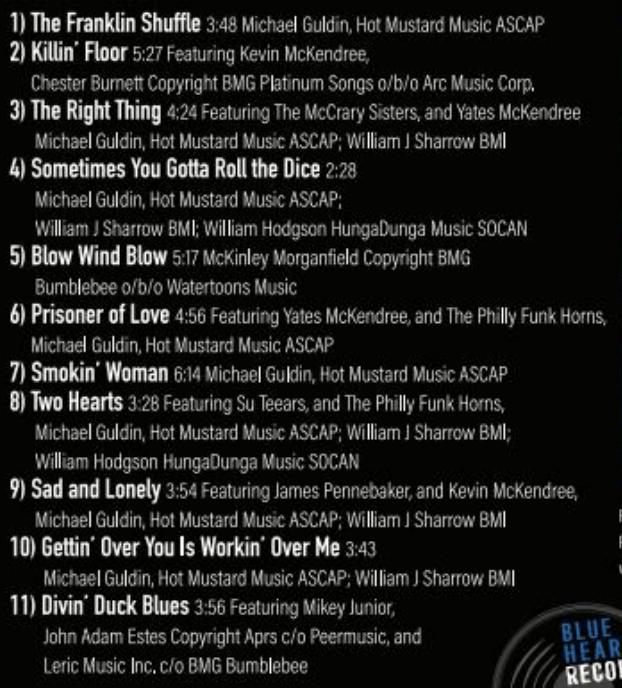
Tracks and more from the CD back cover:

Roadhouse Album Review: Gráinne Duffy’s vocal talents shine in “Dirt Woman Blues”

Gráinne Duffy — “Dirt Woman Blues” — Blue Heart Records

Gráinne Duffy may not be a familiar name to fans of Americana music (roots, blues, folk, country, and all that), but it should be.

Her fifth album, “Dirt Woman Blues,” should help a bunch. Not just because she traveled from her home in Ireland to Southern California to record it (although I’m sure that made a difference), but because she’s a first-class singer, songwriter, guitarist and storyteller.

She and husband / guitarist Paul Sherry wrote the nine originals here, and then filled out their musical lineup with guitarist Marc Ford, formerly of the Black Crowes, Gary Clark Jr.’s Austin rhythm section, drummer/percussionist JJ Johnson and bass/keyboard player Elijah Ford (Marc’s son), plus Grammy-winning producer Chris Goldsmith, Jimmy Hoyson, Sam Goldsmith, John Ginty and Peter Levin.

Duffy’s vocals on this session flow magically from ethereal to earthy; her musical framework roams freely from lyrical to roadhouse tough. And she makes it all sound easy. Her lyrics have made her a three-time Blues Matters Writers’ Poll winner.

The album opener, “Well Well Well,” rocks easily behind strong vocals that set a thematic and musical tone for what’s to come. “Dirt Woman Blues” follows with a slow, steady, rhythmic groove, and a darker story line: “Heaven and hell can’t help me now from the devil within….”

“What’s Going On” is a bluesy vocal turn toward the joys of love, “Running Back To You” is a soft and lovely R&B-tinged track with a lyrical guitar interlude, “Rise Above” delivers rootsy Celtic rhythms.
On “Sweet Liberation,” Duffy opens with slow southern rock feel and then shifts into a ripping Allman Brothers-flavored climax.

Duffy turns more soulward (if that’s possible in this heartfelt collection) with “Hold On To You,” then turns personally and musically defiant with the hard-rocking “Yes I Am.” The closer is “Killycrum,” a gentle, lyrical, acoustic guitar-led tribute to her home in County Monaghan.

In “Dirt Woman Blues,” Gráinne Duffy has given us a thoughtful, intelligent album filled with her soul-stirring vocals and the soaring music that powers them. Fans of all musical flavors should treat themselves to this excellent album and Duffy’s engaging talents.


Digression: The County Monaghan that’s home to Duffy is also home to the long-running (since 1991) Harvest Time Blues Festival, which returned last year after a three-year absence, and which has attracted blues performers from around the world. In addition to local and national artists, the fest has seen some names that are well-known on these shores, including Bobby Rush, Van Morrison, Honeyboy Edwards, Gary Moore, Philip Walker, Guitar Shorty, Eric Bibb, Johnny Dyer, Peter Green, Earl King, Melvin Taylor, Luther Allison, Byther Smith, Long John Hunter, Phil Guy, William Clarke, Coco Montoya, Tommy Castro and Walter Trout.

Now maybe it’s just a coincidence that Duffy grew out of this environment. But maybe not.


Here’s “Dirt Woman Blues”:

1. Well Well Well (4:07)
2. Dirt Woman Blues (3:49)
3. What’s It Going to Be? (3:12)
4. Running Back to You (3:22)
5. Rise Above (3:38)
6. Sweet Liberation (4:55)
7. Hold On to You (4:16)
8. Yes I Am (4:17)
9. Killycrum (3:31)

Roadhouse Album Review: Lil’ Jimmy Reed digs deep into the blues on “Back to Baton Rouge”

Lil Jimmy Reed — “Back to Baton Rouge — Nola Blue Records

From the opening bars of “Down in Virginia,” you can hear the echoes of the legendary Jimmy Reed, who wrote this tough shuffle, accented by a piercing high-end harp, with some very tasty piano runs.

This is the song that opens the new album “Back to Baton Rouge,” but now the artist is Leon Atkins, better known as Lil’ Jimmy Reed. He earned the nickname in 1958, when, as a teenage guitarist and Reed fan, he filled in for the original Reed, who was purportedly too far under the influence to perform himself. Lil’ Jimmy Reed was born.

Fast forward 60-plus years. The original is long gone, but the Lil’ One is 84 and still cranking out the only music he wanted to play in his younger days. He’s since branched out into other blues styles, but “I still stick to my Jimmy Reed numbers.”

He’s joined here by the very young piano man Ben Levin, who at 23 is finely tuned in to some of the great old blues piano masters, despite his youth. Levin and Lil’ Jimmy worked together for a song on Levin’s fourth album, “Take Your Time,” and the
bond apparently stuck. Levin also produced the session.

The rest of the band includes Aron Levin, Ben’s father, on second guitar; Walter Cash on bass; with Ricky Nye and Shorty Star on drums. There are five covers and five originals written by Lil’ Jimmy and/or the Levins.

Although the album’s title pays tribute to the Louisiana area when Lil’ Jimmy grew up and earned his stage name, the music begins with the gritty “Down in Virginia,” one of the many songs instantly recognizable as a Jimmy Reed creation. The harp work is especially memorable.

“They Call Me Lil’ Jimmy” is the story of Lil’ Jimmy’s origin and musical travels, written by Ben Levin, highlighted by stinging guitar; “Wish You Wouldn’t” pairs Reed and Levin trading bluesy solos; “Cincinnati’s The Place to Be” is Reed’s original tribute to Levin’s home town; Levin repays the favor with the lovely and languorous “Back to Baton Rouge.”

Lil’ Jimmy Reed and Ben Levin.

“In The Wee Wee Hours” turns the focus on Levin’s piano in a rugged version of this slow-boogie romp from Joe Liggins and the Honeydrippers; “Engine Light” is a kind of slow shuffle warning of a love breakdown; “I’m The Man Down There,” was a 1965 Jimmy Reed answer song to “It’s a Man Down There” (Interesting explanation below*), and Lil’ Jimmy does it just right.

“A String To Your Heart” is another masterful take on the Reed original, with a stinging guitar intro; and the closer, “Mailbox Blues,” is a fine tribute to Slim Harpo, another Baton Rouge contribution to swampy blues.

This is a deeply felt album of down-home blues. Lil’ Jimmy Reed / Leon Atkins takes his inspiration from Jimmy Reed and transforms it into a set of good old-fashioned blues. Ben Levin on piano is worldly beyond his years, adding a mood that could’ve been ripped from any juke joint. Highly recommended for late-night sipping and listening.


*Interesting explanation as promised above: The story of Jimmy Reed’s 1965 song “I’m The Man Down There” actually begins with the song “One Way Out,” reportedly written in 1960 by Sonny Boy Williamson II (Aleck Miller). Or maybe written with Elmore James. It’s unclear.

Anyway, James recorded the song in late 1960, but his version was not released until 1965. Sonny Boy recorded the song in 1961, and it was released then with some success. In 1965, G.L. Crockett reworked and recorded the song as “It’s a Man Down There.”

These lyrics from “It’s a Man Down There” help explain the answer version:

“Girl, I ain’t going out that door,
“Cause it’s a man down there.
“May be your man, I don’t know.”

Crockett’s version was enough of a hit (number 13 on the Billboard R&B chart) that Jimmy Reed created his version: “I’m The Man Down There.” I guess he just wanted to be The Man.


“They Call Me Lil’ Jimmy” from the new album:

Roadhouse Album Review: Lady J Huston storms through powerful “Groove Me Baby”

Lady J Huston — “Groove Me Baby” — Earwig Music / Unison Productions

Joyce Huston, or Lady J as she is known in the blues world, has been around the music world for a while.

She got her first taste of musical fame as a teenager, singing with Johnnie Johnson, Chuck Berry’s original pianist. And it didn’t hurt that her mother was Loyce (Pickens) Huston, a noted blues and jazz singer in St. Louis.

Then her musical training (including her trumpet playing skills) got her a spot as lead trumpeter touring with Albert King’s band in 1981. She was just 18. It wasn’t too long before she was King’s lead trumpeter, then his musical director.

That’s not a bad way to start your career.

After all that, “Groove Me Baby” is her first full-length studio album. And so this debut session begs the question: What took her so long?

The album overflows with the power of nine original songs (and three outstanding covers), written or co-written by Huston, backed by a lineup of razor-sharp musicians.


Here’s an excellent article by Bob Baugh on STLBlues.net that elaborates nicely on Lady J’s multifaceted career.


The session opener is the original “Your Call,” a tough old-school blues kicked into gear by a horn section that’s done to a crisp. The fierceness of Huston’s commanding vocals set the tone for everything that follows.

“Mean Stud Lover’s Blues” is another terrific, hard-charging blues with a message, and the message ain’t carpentry; On “I Want A Man Like That,” Huston reprises a big and bold jazzy blues sung by her mother in 1963 with the Chick Finney combo; “Tearing Me Apart” is a gorgeous smooth and soulful ballad.

Lady J Huston with Albert King at Club 54 in St. Louis in 1982. Photo: Elcardo Moore Sr.

That’s followed by Huston’s R&B-flavored version of the Albert King classic, “Born Under a Bad Sign;” her ode to the Covid pandemic is the sly uptempo “Corona, You Make Me Sick!;” On “Hide-Away,” Huston adds a strong vocal turn with the Jazz Edge Orchestra, who recorded the track with her in 2019 for a St. Louis Blues Society compilation.

“Groove Me Baby” is sophisticated soul; “Messin’ ‘Round On Da Bayou,” is laced with a funky New Orleans beat driven by Huston’s Las Vegas drummer, Jimmy Prima, nephew of the legendary Louis Prima; he hot swing number “500 Pounds Good Gizzay,” is an almost not-so-double entendre that updates a raucous little ditty from her mother’s repertoire.

Two bonus tracks close it all out: an instrumental take on “Mean Stud Lover’s Blues” so you sing along, and a stirring live version of “At Last,” the Etta James’ classic.

This is, simply put, an outstanding album in every respect. The musicians dramatically underline Huston’s commanding presence and keep her fierce vocals front and center while she storms through the set. Even the slower numbers are steamy enough to fog your soul.

It took long enough for Lady J to cook up this special musical feast; I’m ready for a second helping.


Official video of “Groove Me Baby”:

Tracklist:

01. Your Call
02. Mean Stud Lover’s Blues
03. I Want a Man Like That
04. Tearing Me Apart
05. Born Under a Bad Sign
06. Corona You Make Me Sick!
07. Hide-Away
08. Groove Me Baby
09. Messin’ Around on Da Bayou
10. 500 Pounds Good Gizzay
11. Mean Stud Lover’s Blues
12. At Last (Live)

Roadhouse Album Review: Michael Jerome Browne revives great old folk blues on “Gettin’ Together”

Michael Jerome Browne — “Gettin’ Together” — Borealis Records

There’s nothing like a set of great old acoustic blues to remind us of some of the origins of this classic American music,.

That’s just what Michael Jerome Browne provides on his latest album, “Gettin’ Together,” which he does with a handful of artists who perform 14 songs that reach deep into blues obscurity for much of this session.

Born in Indiana, Browne has lived in Canada since he was nine, where he and his musical versatility became part of Montreal’s coffee-house scene by age 14. He’s since developed into a world-class singer, multi-instrumentalist and musicologist.

More recently, he’s been a three-time Canadian Folk Music Award winner (Traditional Singer, 2015; Solo Artist, 2012 & 2008), won the Blues With A Feeling Award at the 2020 Maple Blues Awards (with 35 nominations since 1999), five-time Juno Award Nominee in both the Roots/Traditional and Blues categories, and Kerrville (Texas) New Folk Finalist.

On this latest session, Browne “gets together” with Harrison Kennedy, J.J. Milteau, Eric Bibb, Mary Flower, John Sebastian, Colin Linden, Stephen Barry, Julian McColgan, Teilhard Frost, and Happy Traum. Browne sings and plays a resonator guitar, tremolo 12-string, or his gourd banjo with this talented group of pickers, harpists, fiddlers, and percussionists.

The result is plenty of fine music, and not incidentally, a history lesson rich in folk music and the blues.

Some of the musical sources here should be very familiar to folk-blues fans: Brownie McGhee, Mississippi John Hurt, Booker White and Mary Flower. But much of the music Browne has picked (literally) for this album includes songs from virtually unknown names, such as Black Boy Shine, Rube Lacy, Bayless Rose and Big Charlie Butler, that go back nearly a century into the 1920s and ’30s.

Browne’s begins this blues time-travel on Hurt’s easy-riding “Monday Morning Blues” from 1928 with his 12-string and Kennedy’s lyrical harmonica. Next, Bibb and Milteau help out on Booker White’s “Shake ‘Em On Down.” Mary Flowers adds lap slide on the instrumental “I’ve Got the Big River Blues” by the Delmore Brothers. Sebastian on harp and Flowers join in on Hurt’s chestnut, “Coffee Blues.”

Just a little historical digression: “Coffee Blues” is the song that provided the name for John Sebastian’s band, the Lovin’ Spoonful, since that phrase is repeated in the lyrics. And now Sebastian turns up here playing harp on “Coffee Blues.” Coincidence? I think not.

Next, Browne duets with Linden on “Ham Hound Crave,” s song by the almost literally unknown Rube Lacy; slide guitarist J.B. Hutto’s electric “Please Help” gets an acoustic makeover; Booker White’s “Fixin’ to Die Blues,” shows up with banjo and fiddle treatment; the instrumental “Reverend Strut” is named after the Rev. Gary Davis, with Browne playing Davis’s original banjo.

“Married Man Blues” is from the little known Houston pianist Harold Holiday, or Black Boy Shine, noting that the original title should have been “Married Woman Blues”; another pairing with Flower on a lap slide produces a plaintive “Black Dog Blues” by Bayless Rose; Flower follows on a 12-string with her own instrumental “Wisecrack.”

A somewhat less obscure William Buch (Peetie Wheatstraw, who also called himself the High Sheriff from Hell or the Devil’s Son-In-Law)) wrote “Six Weeks Old Blues,” followed by “Diamond Joe,” by Big Charlie Butler while in the Parchman Farm Prison in the 1930s. The closer is Brownie McGhee’s “Living with the Blues,” with Browne, Sebastian, McColgan, and Happy Traum join the finale.

That’s a lot of history and a lot of music — there’s much more information in the carefully notated booklet that come with the CD. When you put all that together, it’s a smartly crafted set of acoustic folk blues that goes down easy. Browne has gathered the music and the players and they’ve woven a magical tapestry of this music and its historic sources.


Here’s “Coffee Blues” by Michael Browne:

Tracklist:

1. Monday Morning Blues
2. Shake ‘Em On Down
3. I’ve Got the Big River Blues
4. Coffee Blues
5. Ham Hound Crave
6. Please Help
7. Fixin’ To Die Blues
8. Reverend Strut
9. Married Man Blues
10. Black Dog Blues
11. Six Weeks Old Blues
12. Wisecrack
13. Diamond Joe

Roadhouse News: Here are the winners of the 2023 Blues Music Awards

Tommy Castro is B.B. King entertainer of the year for the second straight year.

Buddy Guy, Albert Castiglia and John Németh were big winners in the Blues Music Awards, held last night (May 11) in Memphis.

The evening’s top award winners were Buddy Guy, Albert Castiglia and John Németh, each earning two BMAs. Buddy Guy’s The Blues Don’t Lie picked up Album of the Year and Contemporary Blues Album. Albert Castiglia won Blues Rock Album as well as Blues Rock Artist, and John Németh’s May be the Last Time won Traditional Blues Album; Németh was also awarded instrumentalist Harmonica.

Here’s a complete list of the nominees and winners. Congratulations to everyone.

B.B. King entertainer of the year 

WINNER: Tommy Castro

Sugaray Rayford

Eric Gales

Bobby Rush

Mr. Sipp (Castro Coleman)

Band of the year 

Anthony Geraci & The Boton Blues Allstars

John Németh and the Blue Dreamers

Rick Estrin and the Nightcats

Southern Avenue

WINNER: Tedeschi Trucks Band

Song of the year

Altered Five Blues Band “Great Minds Drink Alike” (Jeff Schroedl)

WINNER: Buddy Guy “The Blues Don’t Lie” (Tom Hambridge)

Eric Gales “I Want My Crown” (Eric Gales, Joe Bonamassa)

John Németh “The Last Time” (John Németh)

Shemekia Copeland “Too Far to Be Gone” (John Hahn/Will Kimbrough)

Best emerging artist album

Blue Moon Marquee / Scream, Holler & Howl

DaShawn Hickman / Drums, Roots & Steel

WINNER: Dylan Triplett / Who Is He?

Jose Ramirez / Major League Blues

Yates McKendree / Buchanan Lane

Acoustic blues album

WINNER: Charlie Musselwhite / Mississippi Son

Corey Harris / The Insurrection Blues

Duwayne Burnside / Acoustic Burnside

Harrison Kennedy / Thanks for Tomorrow

Rory Block / Ain’t Nobody Worried

Blues rock album

WINNER: Albert Castiglia / I Got Love

Bernard Allison / Highs & Lows

Colin James / Open Road

Eric Gales / Crown

Tinsley Ellis / Devil May Care

Contemporary blues album

WINNER: Buddy Guy / The Blues Don’t Lie

Diunna Greenleaf / I Ain’t Playin’

Janiva Magness / Hard to Kill

Larry McCray / Blues Without You

Shemekia Copeland / Done Come Too Far

Soul blues album

Kat Riggins / Progeny

Kirk Fletcher / Heartache by the Pound

WINNER: Sugaray Rayford / In Too Deep

The Love Light Orchestra / Leave the Light On

Trudy Lynn / Golden Girl

Traditional blues album

Kenny Neal / Straight From the Heart

Bob Corritore / Bob Borritore & Friends: You Shocked Me

Duke Robillard / They Called it Rhythm & Blues

WINNER: John Németh / May Be the Last Time

John Primer / Hard Times

Acoustic blues artist

WINNER: Doug MacLeod

Guy Davis

Harrison Kennedy

Rhiannon Giddens

Rory Block

Blues rock artist

Walter Trout

WINNER: Albert Castiglia

Tommy Castro

Joanne Shaw Taylor

Tinsley Ellis

Contemporary blues female artist

WINNER: Ruthie Foster

Beth Hart

Janiva Magness

Teresa James

Vanessa Collier

Contemporary blues male artist

Selwyn Birchwood

Chris Cain

WINNER: Christone “Kingfish” Ingram

Ronnie Baker Brooks

Mr. Sipp (Castro Coleman)

Soul blues female artist

Annika Chambers

Trudy Lynn

WINNER: Thornetta Davis

Kat Riggins

Vaneese Thomas

Soul blues male artist

John Németh

Johnny Rawls

WINNER: Curtis Salgado

Don Bryant

Billy Price

Traditional blues female artist (Koko Taylor award)

Dietra Farr

Diunna Greenleaf

Rhiannon Giddens

Rory Block

WINNER: Sue Foley

Traditional blues male artist

Billy Branch

Duke Robillard

WINNER: John Primer

Johnny Burgin

Sugar Ray Norcia

Instrumentalist – bass

Bob Stronger

WINNER: Danielle Nicole

Larry Fulcher

Michael “Mudcat” Ward

Willie J. Campbell

Instrumentalist – drums

Chris Layton

Cody Dickinson

Derric D’Mar Martin

WINNER: Kenny “Beedy Eyes” Smith

Tony Braunagel

Instrumentalist – guitar

Chris Cain

Christoffer “Kid” Andersen

Joanna Connor

Kirk Fletcher

WINNER: Laura Chavez

Instrumentalist – harmonica

Billy Branch

Bob Corritore

Jason Ricci

WINNER: John Németh

Dennis Gruenling

Instrumentalist – horn

WINNER: Deanna Bogart

Gregg Piccolo

Jimmy Carpenter

Mark Kaz Kazanoff

Sax Gordon Beadle

Instrumentalist – piano (Pinetop Perkins piano player award)

WINNER: Anthony Geraci

Ben Levin

Dave Keyes

Jim Pugh

Kenny “Blues Boss” Wayne

Instrumentalist – vocals

Curtis Salgado

Danielle Nicole

Diunna Greenleaf

John Németh

WINNER: Shemekia Copeland