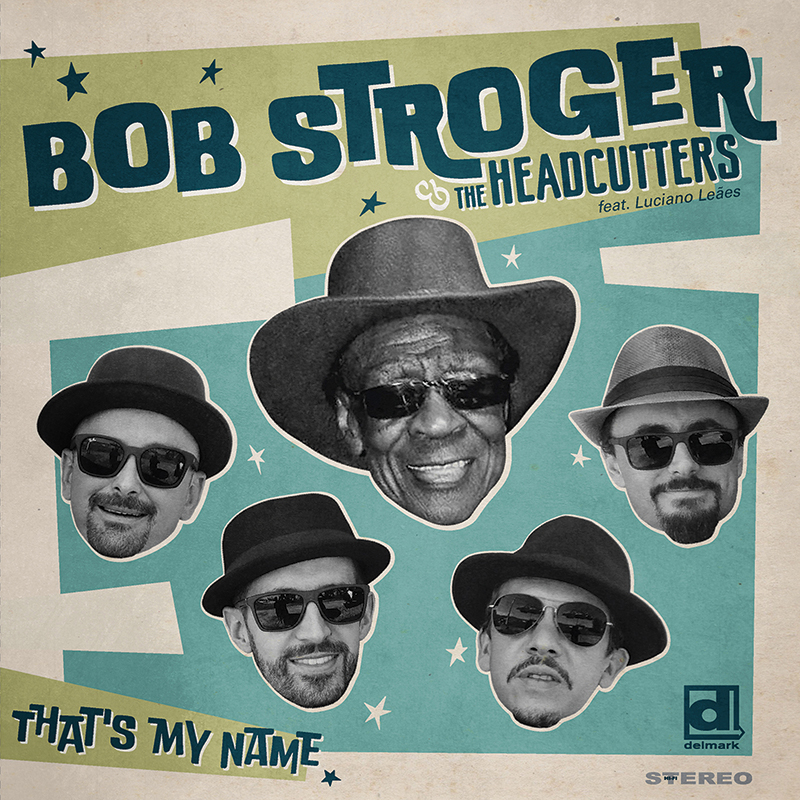
After playing as a sideman on more than 30 Delmark record releases over the years, bassist Bob Stroger finally gets his chance to strut his bluesy bass work as a band leader for the label, at the age of 91, on the album “That’s My Name.”
He does so in front of the Headcutters, a snappy blues quartet from Brazil.
Stroger’s vocals are still smooth and ripe with his feelings for the music. The Headcutters sit back behind the vocals and make their own tough statement, but don’t overwhelm. It makes for fine blues listening.
The Headcutters are Joe Marhofer (harmonica and vocals), Ricardo Maca (guitar), Arthur Catuto (acoustic bass) and Leandro Cavera (drums). They add the special talents of guests Luciano Leaes on piano and organ,, and Braion Johnny on sax.
Stroger has written five of the 13 tracks; the rest are covers of some fine blues chestnuts. The opener is “What Goes On In The Dark,” with its a down-home vibe, followed by Eddie Taylor’s sturdy “Just A Bad Boy,” with a punchy harp, and then the classic “C.C. Rider.” All vintage blues that go down as smooth as good whiskey.
Then Stroger adds a pair of his own: the slow-dragging “I’m A Busy Man,” followed by the bluesy bounce of “Come On Home.” Then Stroger’s version of another classic blues, “Move To The Outskirts of Town,” followed by Jay McShann’s “Keep Your Hands Off Her.”
There are more, all featuring Stroger’s still warm, almost honeyed voice that lends the authority and presence of his 91 years.
He pulls it all together at the end with his own track as some Hammond B3 walks in the closer, “That’s My Name” — “You can call me Bob Stroger, you can call me anything you choose, but my real name is the blues…… I am the blues…”
It’s a shame we had to wait so long to put Stroger out front with his classy, classic blues vocals, but this is an excellent set of good old-fashioned blues from one of its oldest living practitioners. It’s also a tribute to the universality of the music that a Brazilian blues combo seals this real deal.
Here’s a short live take of one of the album tracks, “Pretty Girl”
Track list:
01 What Goes On in the Dark 3:49 (H.PARKER JR.) 02 Just A Bad Boy 3:19 (EDDIE TAYLOR) 03 CC Rider 4:19 (MA RAINEY) 04 I’m A Busy Man 4:34 (ROBERT STROGER) 05 Come On Home 3:44 (ROBERT STROGER) 06 Move to the Outskirts of Town 5:32 (CASEY BILL) 07 Keep Your Hands Off Her 3:25 (JAY McSHANN) 08 Something Strange 3:21 (ROBERT STROGER) 09 Stranded in St. Louis 4:55 (H. PARKER JR.) 10 Pretty Girls 3:05 (EUGENE CHURCH) 11 Talk to Me Mama 4:07 (ROBERT STROGER) 12 Just A Dream 4:54 (BIG BILL BROONZY) 13 That’s My Name 4:18 (ROBERT STROGER)
Libation note: This review was, of course, inspired by this great music, but partially fueled by some excellent Old Grand-Dad, laced with a lovin’ spoonful of Benedectine.
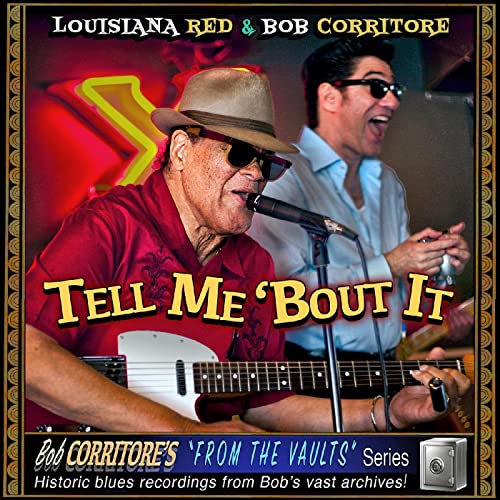
It’s always a pleasure to find a new release from harp-master Bob Corritore’s treasure trove of great old blues music — his “From the Vaults” series.
This time he celebrates the unique blues guitar stylings and prolific songwriting skills of the too-often overlooked Louisiana Red.
Red, whose real name was Iverson Minter, was something of a blues vagabond, although in his younger years, he lived where his family took him. He was born in Bessemer, Ala., and his mother died of pneumonia shortly after his birth. His father was lynched by the Ku Klux Klan in 1937, when he was five.
He was then raised by relatives in various places, including Pittsburgh, where he reportedly learned to play the blues. The Pittsburgh Music History website describes those years:
“In his teens Iverson moved to Canonsburg, Pa., (south of Pittsburgh) to live with an aunt and uncle. He moved into the city of Pittsburgh with his grandmother in the late 1940’s. One day in Pittsburgh, Red heard blues guitarist Crit Walters playing on his porch. Walters (also known as Boy B) serenaded passers-by every day with down home blues. Red asked Walters to teach him the blues. Red also studied wtih another Pittsburgh bluesman named Mr. Cash. After learning the basics from Walters and Cash, Red and his friend Orville Whitney formed a three-piece band composed of a washboard player, a washtub bass player, and himself on bottleneck guitar. They performed on the streets of Pittsburgh for pennies, earning $5 dollars on a good night. Red’s 1995 release “Sittin Here Wonderin'” features his song “Pittsburgh Blues.”
And in an interesting sidelight to that, I remember seeing Red at the The Decade, a long-gone but musically vital club in the Oakland section of Pittsburgh, probably in the late ’70s, shortly before he moved to Hanover, Germany, in 1981, where he lived until his death in 2012.
Red’s music was usually an old-style acoustic, down-home blues with a fierce slide and lyrics that told stories often taken from his past, if not his wonderfully fertile imagination. He lived a little too late to be considered with the early pre-war acoustic players, and he didn’t adopt the electric blues combo style that came to dominate the post-war blues years. So his creative songwriting and stinging slide often got lost in the blues world. But Red recorded 50 albums and carried his music around the world until he died.
This album was recorded at seven different sessions between 2000 and 2009 with Corritore, who became Red’s close friends during their Chicago years. Other musicians involved in these tracks include Chico Chism, David Maxwell, Bob Margolin, Little Victor, Buddy Reed, Johnny Rapp, Chris James, Patrick Rynn, and Brian Fahey.
All this is to introduce, or re-introduce you to the music of Louisiana Red. This album is tough, old-fashioned blues, played by Red with a passionate guitar attack combined with an evil-sounding slide, which could range from angry to ethereal.
About that name: It was a nickname given to him as a child by his grandfather because he really liked “Louisiana Red” hot sauce.
This is truly classic blues material, a hot sauce in its own way. Enjoy it and thank Bob Corritore for preserving it.
“New Jersey Blues,” from the new album:
“Thirty Dirty Woman” from a concert in Switzerland in 1986, to give you an idea of Red’s guitar work:
Track list:
01. Mary Dee Shuffle (05:01) 02. Early Morning Blues (03:59) 03. Alabama Train (03:32) 04. Caught Your Man And Gone (04:55) 05. New Jersey Blues (05:30) 06. Freight Train To Ride (03:56) 07. Tell Me ‘Bout It (04:09) 08. Earline Who’s Been Foolin’ You (03:24) 09. Edith Mae (04:29) 10. Bessemer Blues (04:51) 11. Bernice Blues (06:15)
And why not? He’s covered just about every bluesy style from old-school Chicago to heart-wrenching soul to thoroughly greasified funk ‘n’ stuff.
What makes it all sound so good is that he doesn’t just cover the music, he creates it, after filtering it through his finely tuned musical sensibilities honed as a young man growing up in Boise, Idaho, not normally known as fertile soil for the blues.
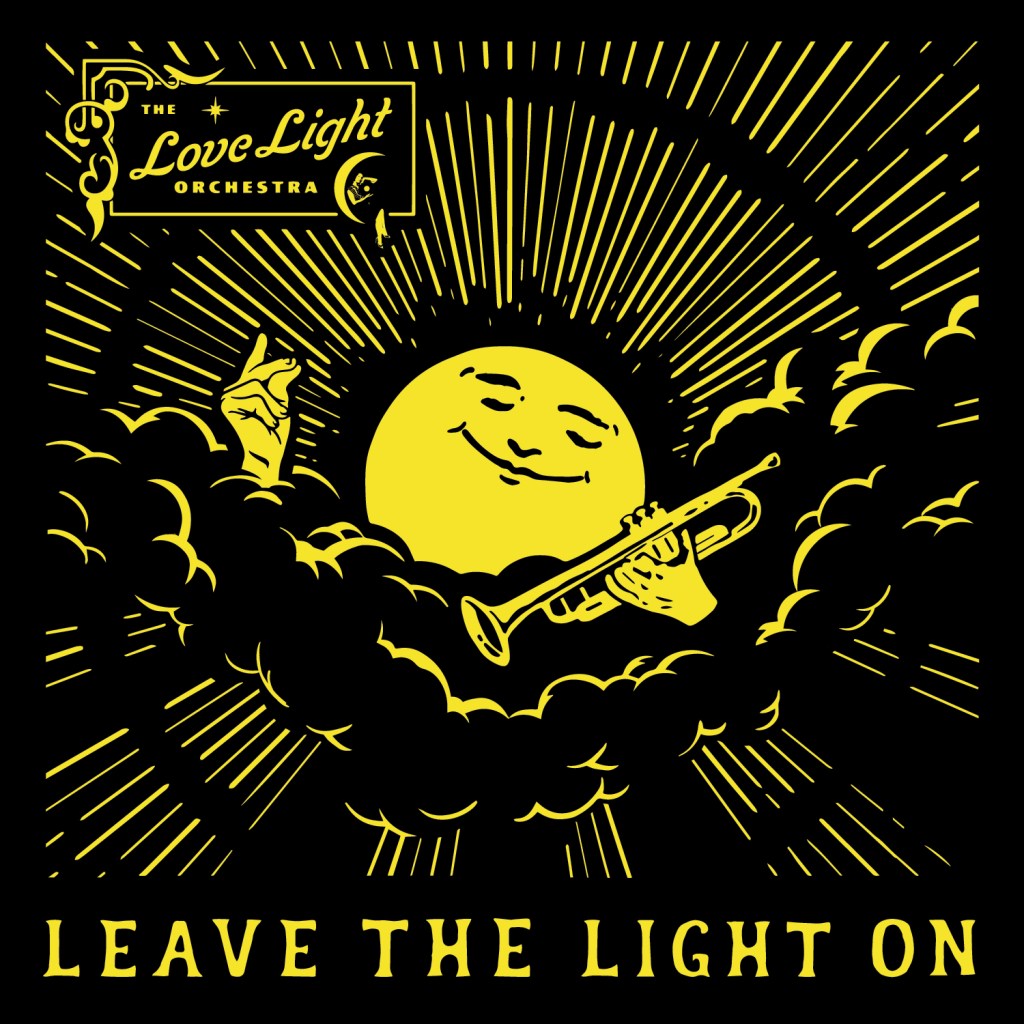
To be fair, this isn’t the first pairing of Németh with the very fine Love Light Orchestra. They recorded a set at Bar DKDC in Memphis in 2017 that crackled with all the electric enthusiasm that a live show generates.
Now they’ve released this excellent studio recording, and it’s still electric. This group (you can find its impressive membership list at the end of this post) is big-band sound at its best. It stomps, it swings, it jumps with style and substance from the opening bars to its final echoes. And when you wrap this glistening sound around Németh’s stunning vocals, the result is a magical visit to a musical era that once defined the shape of American music.
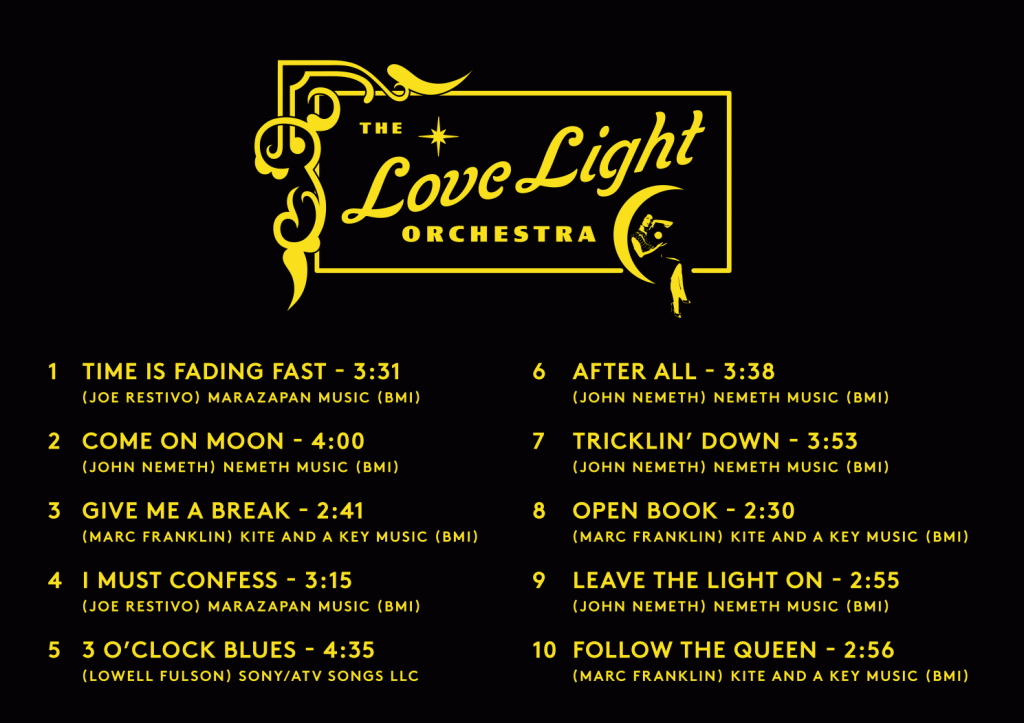
The music itself is almost all original, composed by Németh or guitarist Joe Restivo or arranger/ trumpeter Marc Franklin. And the thing is, they’ve created new music that reflects all the great qualities of the original, performed to perfection. And the one cover they do, the scorching blues of “3 O’Clock Blues” by Lowell Fulson, fits right in.
But the most notable work here might well be from Németh himself, who hoses away most of that funky grease to reveal pipes that sparkle and shine with the essence of the big-band shouter.
From the swinging opening notes of the first track, Restivo’s “Time Is Fading Fast,” Németh’s vocals open up with a richness, depth and soulfulness usually associated with the likes of Jimmy Rushing or Big Joe Turner. Fast company, for sure, but John sounds like he was born into this family. “Come On Moon” by Németh swings up next, soaring on the wings of a pulsating Love Light rhythm section. “Give Me A Break” by Franklin follows, driven by the punchy riffs of the band’s razor-sharp horns.
There are seven more fabulous tracks here, each one a minor masterpiece of vocal prowess and musical invention by masters of their craft. I could tell you how much I like each one by name, but then you would just have more stuff to read before you get to listen to this music.
So yeah, I love this album. It’s damn fine music; some of the most enjoyable I’ve heard in a long time.
By the way, Bobby “Blue” Bland’s 1961 hit “Turn On Your Love Light,” was the inspiration for Restivo and Franklin giving the band its name.
Here’s “Come On Moon”:
Tracklist and credits
Artist Highlights · John Németh – 2-time Blues Music Award winner and 23-time nominee; soul blues vocalist, songwriter, harmonica player and international touring artist. · Joe Restivo – international recording and touring artist with the Bo-Keys; jazz DJ on WEVL, performed regularly with Mose Vinson (RIP) and Charlie Wood, · Marc Franklin – co-founder of The Bo-Keys, arranger, and trumpet player; (session artist for Aretha Franklin, B.B. King, Buddy Guy, William Bell, Booker T & The MGs; performed with Bobby “Blue” Bland, Gregg Allman). · Paul McKinney – trumpeter and member of Memphis R&B Allstars, · Jason Yasinksy – trombonist on both albums, · Art Edmaiston – international performing saxophone player (Bobby “Blue” Bland, Levon Helm, William Bell, Hi Rhythm Section, Jason Isbell, The Bo-Keys, Dr. John, The Allman Brothers Band). · Kirk Smothers – international performing saxophone player (The Bo-Keys, Buddy Guy, Don Bryant, Jason Isbell, Vaneese Thomas). · Tim Goodwin (RIP) – University of Memphis Professor Emeritus, recipient of Memphis Chapter NARAS’s Premier Bassist Award (2002). · Matthew Wilson – international touring artist (Nick Moss Band, John Paul Keith, The Blue Dreamers), · Gerald Stephens – U of Memphis masters in piano performance; professor of Jazz Piano at Rhodes College; 20+ year Memphis area performer. · Earl Lowe – U of Memphis alum; drummer on both albums. · Al Gamble – Hammond B3 organist and pianist (The Bo-Keys, Marc Broussard, John Paul Keith, St. Paul and The Broken Bones) (NOT BAND MEMBER). · Scott Thompson – GRAMMY-winning trumpet player (Robert Cray, Otis Rush); U of Memphis masters in jazz pedagogy; session and touring artist (Al Green, Aretha Franklin, Ray Charles, Rufus Thomas) (NOT BAND MEMBER).
Angela Easley’s vocal style covers a lot of fertile ground, rooted in her native Mississippi and blooming now in Nashville.
It can be a smoldering orchestral tapestry with a touch of gospel, as in “I Can Let Go,” the album’s opener led by Easley’s piano, with the sweet harmonies of The McCrary Sisters rippling around her. Or it can be the smart and sassy “Runnin’ Out of Time,” laced with horns and bouncing with a danceable beat. Or it can be a soaring duet with Shelly Fairchild on emotionally powerful title track, “Rise.”
Then there’s the tough rocking of “Don’t Let the Devil Down,” followed by the plaintive soul in “One More Last Time.” It’s all wrapped up in the country-comfort of the smooth “Crazy Rain.”
Easley is a co-writer on all the tracks except “One More Last Time,” which is hers alone, and all of them display an intelligent feel for elegant lyricism and musical arrangements.
Easley’s voice, style and songwriting sensibilities evoke both the tenderness and toughness of Southern soul, with enough blues to make your heart ache in just the right places. The band provides its own emotional support system.
There’s only one big problem with this album — it’s only six songs long. I guess it’s what passes for an EP these days (the concept having been created by RCA in 1952 for the 45rpm format. There were 28 Elvis Presley EPs, for example, some of which I confess to having owned).
But I digress.
Easley’s voice just demands much more listening pleasure than you can get here. Check her out at the Bourbon Street Blues & Boogie Bar in Nashville, where she’s been a regular for four years. Or take a look at her YouTube channel.
Tracklist and credits:
1 I Can Let Go (Featuring The McCrary Sisters) 4:00 Written by Travis Bowlin, Herb Aaron, Angela Easley 2 Runnin’ Out Of Time 3:48 Written by Russ Harkins, Angela Easley 3 Rise (Featuring Shelly Fairchild) 4:55 Written by Dave Isaacs, Angela Easley 4 Don’t Let The Devil Down 3:31 Written by Lori Kelley, Angela Easley 5 One More Last Time 4:18 Written by Angela Easley 6 Crazy Rain 5:26 Written by Dave Isaacs, John Miner, Angela Easley Produced by Walter Scott & Angela Easley Mixed & Mastered by Bob Olhsson Photography by Bryan Collins Angela Easley, Piano / Walter Scott, B3 Organ / Calvin Johnson, Bass Brian Czach, Drums / Marcus Finnie, Drums (Track 2) Randy Peterson, Guitar / Billy Contreras, Violin (Track 5) Matthew Gros, Saxophone / Micah Holman, Saxophone (Track 4) Garen Webb, Trombone / Roy Agee, Trombone (Track 2) Kiran Gupta, Trumpet / Jim Williamson, Trumpet (Track 2) Shelly Fairchild, Background Vocals Heidi Burson, Background Vocals The McCrary Sisters, Background Vocals (Track 1) Beverly McCrary / Deborah McCrary
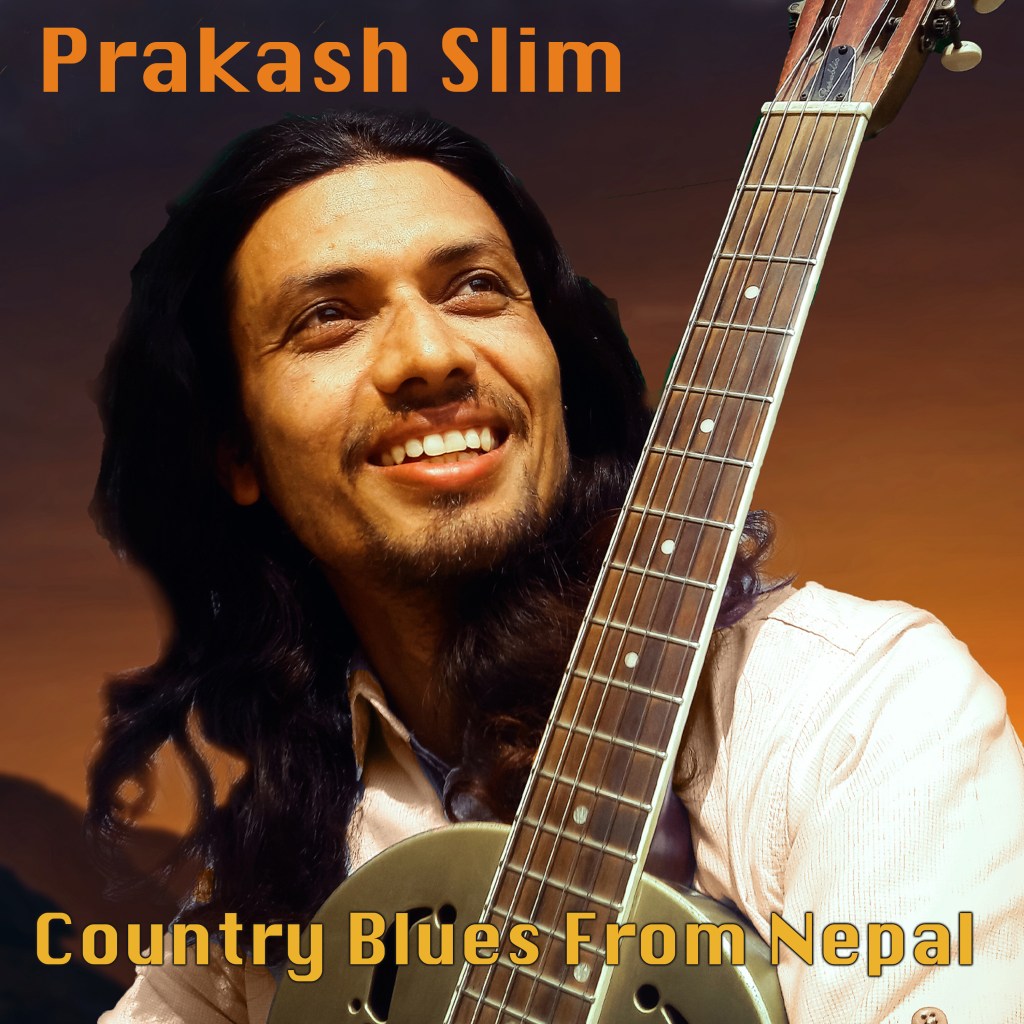
Prakash Slim — “Country Blues from Nepal” — DeVille Records
Ram Prakash Pokharel, or Prakash Slim, living in his native Nepal, is proving what all blues music lovers instinctively know — that the music of the blues has no borders.
In his case, the music that’s crossed his border and captured his spirit is the very distinctive acoustic country blues, essentially the classical music of the blues genre.
Prakash has just released his first album, very appropriately titled, “Country Blues From Nepal,” featuring seven classics from the style as well as six of his own compositions.
The classics he picks here show off the strength of Prakash’s vision and talent. There are covers of “Jitterbug Swing” (Bukka White), “Moon Going Down” (Charley Patton), “Me and the Devil Blues” and “Crossroad Blues” (Robert Johnson), “You Gotta Move” (Mississippi Fred McDowell), “Police Dog Blues” (Blind Blake).
That’s an ambitious undertaking, but Prakash pulls it off nicely. His interpretations flow easily, and his guitar work is excellent — traditional country with the added touch of a hint of Nepalese influence. It gives his music a sort of ethereal quality that makes for a welcome counterpoint to the harshness of some country blues.
Prakash has also added six of his own songs in the same style, but based on his own experiences — his life in Nepal. I think these are even more interesting than his covers. It takes a genuine sensitivity to the musical style and its origins to create your own versions and still have sound original. The guitar work on these tracks displays a little more of Prakash’s unique flavor. The tracks include “Blues Raga,” “Living for the Memory,” “Villager’s Blues,” “Corona Blues,” and “Poor Boy.”
The two final songs — “Bhariya Blues” and “Garib Keto” — are sung in Prakash’s Nepali language. He explained them in a recent email exchange:
“Those two songs are in my native Nepali Language. “Garib Keto” is a Nepali version of “Poor Boy” and lyrics and meaning are the same too. “Bhariya Blues” is about a porter’s life, and it says every morning the porter needs to go downtown carrying heavy loads by crossing a dark forest and wild stream.”
“People dominate him by saying porter all the time but he says he hasn’t done any wrong although people tease him, saying beggar. He takes breakfast at a tea shop on the way and he says he will pay money before dying if owner asks him. He dreams about to buy new clothes for his son, but he can beg for himself. He says he writes a letter to his father and mother with love and greetings, and says he sends mail by the air because he doesn’t have money for post office. He can only breathe by putting heavy loads somewhere on the way but he gets full rest remembering his family all the time.”
All in all, this is a very interesting, very enjoyable take on the country blues style. Prakash’s vocals are uniquely his own, but still reflect their heritage, tinged with some international intrigue.
It’s all just another way of testifying that the blues is indeed a universal language.
Here’s an endorsement of Prakash’s country blues style from Rory Block, who has her own impeccable credentials in acoustic country blues — she’s simply one of the very best.
Prakash Slim’s version of “Police Dog Blues,” also found on this album:
The Blues Foundation will reveal the winners in Memphis on May 5, following the Blues Hall of Fame Induction Ceremony May 4.
Here are the nominees:
B.B. King Entertainer Tommy Castro Eric Gales Mr. Sipp (Castro Coleman) J.P. Soars Sugaray Rayford
Album of the Year Holler If You Hear Me, Altered Five Blues Band Not In My Lifetime, Wee Willie Walker & The Anthony Paule Soul Orchestra Pinky’s Blues, Sue Foley Raisin’ Cain, Chris Cain Tommy Castro Presents A Bluesman Came To Town, Tommy Castro
Band of the Year Anthony Paule Soul Orchestra J.P. Soars and the Red Hots Lil’ Ed & the Blues Imperials Sugaray Rayford Band Tommy Castro & The Painkillers
Song of the Year “Fragile Peace and Certain War”, written and performed by Carolyn Wonderland “Holler If You Hear Me”, written by Jeff Schroedl & Mark Solveson (performed by Altered Five Blues Band) “I’d Climb Mountains”, written and performed by Selwyn Birchwood “Real Good Lie”, written by Christine Vitale, Larry Batiste, & Anthony Paule (performed by Wee Willie Walker & The Anthony Paule Soul Orchestra) “Somewhere”, written by Tommy Castro & Tom Hambridge (performed by Tommy Castro)
Best Emerging Artist Album GA-20 Does Hound Dog Taylor: Try It… You Might Like It!, GA-20 Just Say The Word, Gabe Stillman Live On Beale Street: A Tribute To Bobby “Blue” Bland, Rodd Bland and the Members Only Band Welcome To The Land, Memphissippi Sounds You Ain’t Unlucky, Veronica Lewis
Acoustic Blues Album Dear America, Eric Bibb Land of the Sky, Catfish Keith Let’s Get Happy Together, Maria Muldaur Let Loose Those Chains, Hector Anchondo The Trio Sessions, EG Kight
Blues Rock Album Alafia Moon, Damon Fowler Dance Songs For Hard Times, The Reverend Peyton’s Big Damn Band Resurrection, Mike Zito Tinfoil Hat, Popa Chubby Unemployed Highly Annoyed, Jeremiah Johnson
Contemporary Blues Album 662, Kingfish Damage Control, Curtis Salgado Holler If You Hear Me, Altered Five Blues Band Raisin’ Cain, Chris Cain Tommy Castro Presents A Bluesman Came To Town, Tommy Castro
Soul Blues Album Let’s Have A Party, Gerald McClendon Long As I Got My Guitar, Zac Harmon Not In My Lifetime, Wee Willie Walker & The Anthony Paule Soul Orchestra You Get What You Give: Duets, Dave Keller You Gotta Have It, Tia Carroll
Traditional Blues Album Be Ready When I Call You, Guy Davis Bob Corritore & Friends: Spider In My Stew, Bob Corritore Boogie w/ R.L. Boyce (Live), R.L. Boyce Little Black Flies, Eddie 9V Pinky’s Blues, Sue Foley
Reddog and Friends — “Booze, Blues and Southern Grooves” — Survival South Records
Fine and mellow.
That’s the description that comes to mind after listening to the latest soulful album from Reddog and Friends, his sixth, and his first since 1993’s “After the Rain.”
And just who is Reddog?
At first it was the name of his band, a staple in the Atlanta area for decades, and now working out of the Pensacola, Fla., area.
“I spotted an advertisement for a vintage clothing store named Reddog, and the ad had beautiful, long, lean, red dogs,” Reddog told author/blogger Cindi Brown. “I thought it would be a good band name. As band personnel changed over the years, everyone just started calling me Reddog.”
Reddog himself is Jeff Higgins, a singer with a laid-back vibe; a songwriter with a lyrical ear, and a guitarist who favors “soulful Southern blues.” His vocals here are mellow; tastefully simmered inside slow-burning guitar licks. His style is a fine example of how less can be more, letting the soul pour freely into the space between the notes.
Right from the opening track, “Love, You’ve Got to Spread the Word,” with its smooth groove and soothing message, sets the tone. Backup singers Carla Russell, Mary Mason and Angela Hacker add authentic harmonious sentiments here and throughout. Their vocals add an excellent touch.
“The Blues Will Get You Everytime” follows, a hand-clapping ode to the power of the music. “Down, Down, Down” is slow and torchy, “She’s a Georgia Peach” is ripe with rhythm. “Simple Song” is anything but, letting gorgeous backup vocals break free. “Searching for Some Soul” shuffles along nicely, sort of a theme song for the entire album. These aren’t all of the excellent original eleven tracks, but they’re some of my favorites. The final cut, “Honest Man,” makes its case as a lyrical summation — possibly Reddog’s personal blues creed.
This is an album full of thoughtful, entertaining, excellent music from someone whose voice needs to added to the blues conversation after a long absence from the national scene. The notes below from Reddog describe his friends, and how they came to record this album.
And by the way, “Fine and Mellow” is not just a clever lead-in to this article, although I think the phrase captures Reddog’s spirit nicely. It was one of the few songs written by the great Billie Holiday, and its presentation in 1957 was arguably one of the great live musical performances in TV history.
A few words from Reddog about recording this album:
My music style is soulful, Southern blues. That’s how I describe my music. I want the listener to hear it but also feel it! Muscle Shoals, Alabama was where I needed to record to get that sound.
Johnny Sandlin asked me if I’d like him to bring in any special musicians for my CD. My only request was Clayton Ivey on keyboards and Johnny looked at me like, how the hell do you even know who Clayton Ivey is? I knew!
When I saw David Hood in Muscle Shoals it had been about 20 years since we had been in a studio together. As we were leaving he said “Reddog let’s get together and do this again in 20 years.” He’s funny. He’s one of the best session players ever! He plays the changes, creates a groove and plays melodically all at one time, without missing a beat.
Tracks 5. Simple Song, track 6. Searching for Some Soul, and track 11. Honest Man were recorded at Johnny Sandlin’s Duck Tape Studio in Decatur, Alabama. Players were Reddog guitar, Clayton Ivey keyboards, David Hood bass and Bill Stewart drums.
All other tracks were recorded at East Avalon Recorders in Muscle Shoals, Alabama. Players were Reddog guitar, Clayton Ivey keyboards, David Hood bass, Justin Holder drums.
So the same players were on all the tracks with the exception of drummers. Bill Stewart played drums at Johnny Sandlin’s studio and Justin Holder played drums in Muscle Shoals.
One thing unique to Muscle Shoals, they want the music being recorded there to sound great! Everyone involved is working as a team to make your songs shine. They have a way of making you feel like your recording is the only thing going on in town. It’s inspiring!
Recording songs like “Searching for Some Soul” and “She’s a Georgia Peach” were pure fun to record. We were laughing and cutting up during the process. As much fun as we were having, I hope the listener has to put a smile on! “Simple Song” was inspired by the late great Eddie Hinton from NW Alabama.
Track list and credits:
Love, You’ve Got to Spread the Word (4:39) The Blues Will Get You Everytime (3:55) Down, Down, Down (4:54) She’s a Georgia Peach (4:23) Simple Song (5:42) Searching for Some Soul (3:53) Why Oh Why Are You Calling Me (4:20) Don’t Muscle that Shuffle (3:56) Old School Blues (4:15) Back in the Bottle Again (3:43) Honest Man (4:54)
Reddog: Guitar, Slide Guitar, Vocals; Clayton Ivey: Keyboards; David Hood: Bass; Justin Holder or Bill Stewart: Drums; Carla Russell, Mary Mason, Angela Hacker: Female Vocals; Stevie Hawkins: Congas
“Fine and Mellow,” with Billie Holiday and one of the finest jazz ensembles, live in 1957:
Peter Veteska & Blues Train is a solid, bluesy band that works the East Coast from Maine to Florida, and, not incidentally, a New York Blues Hall of Fame inductee, has just released its sixth album since 2014.
Eight of the 12 tracks are originals, and the album takes a blusier spin than his previous releases.
Of this latest album, Veteska says: “So Far So Good” is my sixth album since 2014 and captures the period from January to July of 2021, a time when I felt driven to write music, explore influences old and new, and create an album that reflects where I’ve been as an artist as well as where I’m headed.”
The basic band lineup of the Train, New York Blues Hall of Fame inductees, is Veteska on guitar and vocals, Coo Moe Jhee on bass, Alex D’Agnese on drums. But for this session they brought along Jeff Levine on keyboards, plus Garry Neuwirth, Mikey Junior, Roger Girke, Rick Prince and Jenny Barnes. And they threw in some horns from Tommy LaBella, Steve Jankowski, and Doug DeHays.
The result is a smart, sophisticated set of blues that kicks off with the tough, rocking “Done With Bad Luck,” with harp and B3 kicking things along. Following that, Veteska shifts into a warm, pensive mode with “I’ve Got the Blues This Morning,” driven by Levine’s subtle piano rhythms. “I Miss You So” is a sparkling, bluesy duet with Jenny Barnes. Veteska also stretches out with steamy guitar and vocals on the torchy “Low Down Dirty Blues” — one of my favorite cuts.
Veteska has a great feel for creating his own blues, and also knows exactly how to pick a great cover song. They give James Cotton’s “Young Bold Women” a workout; add some spicy horns for Guitar Slim’s classic, ”You Give Me Nothing But The Blues,” with another Barnes duet, and steps out nicely with Johnnie Johnson’s “Baby Please,” a jump blues with a swinging big band feel.
Veteska and his mates have produced a fine album here, one that swings easily through a variety of blues styles, all done with a natural feel for their music. Keep the blues coming.
Here’s the title track: “So Far So Good”
Tracklist
Done with Bad Luck (4:28) I’ve Got the Blues This Morning (4:24) I Miss You So (5:16) My One and Only Muse (4:17) Young Bold Women (4:46) Lovin’ Oven (4:26) You Gave Me Nothing but the Blues (4:31) Low Down Dirty Blues (3:53) Baby Please (3:46) East Coast Blues (5:01) So Far so Good (4:41) Can’t We All Get Along (4:31)
Ahhhh. Sweet soul music, that cool, smooth, sexy cousin of the blues.
Somewhere in the 1950s, various artists started to pull together musical strains from blues, R&B, gospel, jazz and a few other interesting places, and the idea of something called “soul music” simmered into its primal origins. Ray Charles and Sam Cooke played the fervency of black gospel into their own rhythms, with some blues. James Brown became the “godfather of soul” with some of his early work. Aretha Franklin later became the “queen of soul.”
But soul music had wider origins. According to the Acoustic Music organization, the “first clear evidence of soul music shows up with the “5” Royales, an ex-gospel group, formerly the Royals, who turned to R&B in the early 1950s, and in Faye Adams, whose 1953 “Shake A Hand” becomes an R&B standard” — eventually covered by everyone from Red Foley to Paul McCartney.
Solomon Burke, early undated photo.
As an interesting sidelight (and there are many when you start to trace musical genres), another group that also called itself the Royals (formerly the Four Falcons), brought in Hank Ballard and then became the Midnighters, and went on to specialize in some raucously salacious R&B (“Work With Me Annie,” “Annie Had A Baby”). The other Royals (formerly the Royal Sons Quintet, a gospel group), became the “5” Royales, and left gospel for something more akin to the devil’s music. I know, you need a scorecard.
But all of that music was initially kind of sporadic. It needed a special force to unite those early elements.
Enter the special force of Solomon Vincent McDonald Burke (born James Solomon McDonald). So special that Burke was consecrated a bishop at birth by his grandmother in the Solomon’s Temple, a congregation of the United House of Prayer for All People, which she founded at her home in Black Bottom, West Philadelphia.
And what an entrance he made. A big man with a big voice, he rolled out several big hits, starting in 1961, and soul music hit the stage testifying.
Music writer Peter Guralnick was among those who recognized Burke as a key figure in the emergence of soul music, and Atlantic Records as the key record label. Burke’s early 1960s songs, including “Cry to Me”, “Just Out of Reach (Of My Two Open Arms)” and “Down in the Valley” became almost instant classics.
According to Guralnick (whose elaborate and well-researched portraits of muisical performers should be required reading for any music lover):
“Soul started, in a sense, with the 1961 success of Solomon Burke’s “Just Out Of Reach (Of My Two Open Arms)”. Ray Charles, of course, had already enjoyed enormous success (also on Atlantic), as had James Brown and Sam Cooke — primarily in a pop vein. Each of these singers, though, could be looked upon as an isolated phenomenon; it was only with the coming together of Burke and Atlantic Records that you could begin to see anything even resembling a movement.”
Indeed, it was Atlantic Records executive Jerry Wexler who called Burke “the greatest male soul singer of all time”.
Burke had recorded since 1955 for the Apollo label, but when he joined Atlantic in 1961, with its fierce sensibilities of blues-related music, his powerful presence oozed soul from every recorded groove. He followed “Just Out Of Reach,” a cover of a country song from the early ’50s, with “Cry To Me,” which would become one of his most popular songs, and “Down In The Valley.”
Those songs, sung in Burke’s rich, sensual baritone with impeccable vocal craftmanship, seemed to pull together the best of gospel, country and R&B, and blend them into a uniquely soulful sound. It could be high and lonesome, or it could be deep and moving. But it almost always seemed to deal emotionally with the pleasures and pains of love.
Love lost, love found, longing for love, hoping for love, dreaming of love — all became soulful themes explored in song, and the best of the singers breathed a real and aching life into their words. Burke was one of the best. But he took other styles under his wing as well. The basic ingredient of the music — gospel style singing with a secular message — seems never to have left him.
Burke’s second pressing and first hit for Atlantic, “Just Out Of Reach (Of My Two Open Arms”), ” seemed to open its arms to all of those loving feelings. It was a great song for verrry slowww dancing, and longing for that love that was, of course, just out of reach. But the B side of that record, as if to hedge his bets against this new-found style, sent a different message — it was the hard-rocking “Be-Bop Grandma.” Of course, Burke could sing anything and make it sound unique. One example: he later covered Bob Dylan’s slyly loquacious “Maggie’s Farm.”
Solomon Burke in 2010 (By HagenU)
Then came another classic, 1962’s “Cry To Me,” another ode to lost love, but with an upbeat, slightly Latin feel. Still good for dancing, though. This one, however, was backed with another great soul tune, “I Almost Lost My Mind,” the 1950 classic by Ivory Joe Hunter. If anyone could possibly improve on this super-smooth lost-love lament, it was Burke, who caressed the lyrics like the wind caressed the trees. (Another interesting sidelight: Ivory Joe Hunter was Ivory Joe Hunter’s real name.)
Later in 1962, Burke recorded his take on the traditional folk/country song, “Down in the Valley, which was actually the B side of another soulful gem, “I’m Hanging Up My Heart for You.” “Valley” was a little different – a mournful country-style ballad with such a rich vocal effort; it was a pleasure to enjoy its mournfulness.
And the soul just kept coming. There was “greatest hits” album as early as 1962. Until the mid-60s, Burke’s music was a dominant force. After a string of a dozen hit records, by November, 1963, Burke greed to be crowned the “King of Rock ‘n’ Soul” in a ceremony at the Royal Theatre in Baltimore by local disc jockey Fred Robinson.
But nothing lasts forever. Burkes’s popularity (but not his magnificent voice and presence) began to wane. By the end of the ’60s, the torch of soul was passing to the likes of the very talented, capable and soulful Al Green, Johnn Adams, Otis Clay, Aretha Franklin, Wilson Pickett, Ray Charles, Otis Redding, Etta James, Clyde McPhatter, Jackie Wilson, and many, many more.
Burke continued to record prolifically until 2010, the year that he died, when he recorded his two final albums. His musical legacy remains intact in the dozens of albums he recorded. A lot of soul music came after his decline in popularity, but very few artists ever matched his powerful body of work or his passionate feeling for the music.
He gave soul music its soul. It’s also the meaningful kind of music that lets you look inward, into your soul, if you will. You can dance around the kitchen to the rhythms of “Cry To Me,” or you can savor your soulful solitude with the haunting lyricism of “Just Out Of Reach.”
I know there are many soul artists, both before and after Burke that I haven’t mentioned. I know because I listen to their music quite often. I don’t mean to slight anyone, only to put Burke’s music into a different perspective.
Ahhhh. Sweet soul music, that cool, smooth, sexy cousin of the blues. Long may it sing.
Here are some more reference points for soul music.
When you hear about, or even better, hear Tinsley Ellis sing and play guitar, some of the words that often come to mind include fiery, passionate, torrid and gritty.
They come to mind because they are all true.
Ellis, with 10 heady new originals on his 20th album (back at Alligator, where he debuted in 1988 with “Georgia Blue”), fills these tracks with his trademark scorching guitar and vocals.
Ellis draws on blues, rock, Southern rock and great guitar traditions for his work, but it’s all filtered through his own personal style. And his songwriting skills reflect the lively invention of his guitar work.
The two opening tracks kick everything off with some good, old-fashioned Southern rock — “One Less Reason” and “Right Down the Drain” are both high-powered, guitar-driven rockers. But Ellis scorches just as much when he tempers that unbridled guitar passion with the slow-burning intensity of “Just Like Rain” (with co-producer and keyboard wizard Kevin McKendree steaming over the B3), a torchy “Don’t Bury Our Love” and the blues-infused “Slow Train To Hell.”
There’s plenty more for the blues-rock fans, and Ellis doesn’t disappoint with a fiery collection that includes “28 Days,” “Juju,” “Step Up” and “One Last Ride,” all pulsing with hair-raising guitar licks driving his crackling band — McKendree on organ and piano, Steve Mackey on bass, and Lynn Williams on drums and percussion.
Ellis used his Covid time off to explore his music in multiple ways: “There was a lot of time to experiment. In my downstairs studio I set up every guitar and amp that I owned, plus a Leslie cabinet, an old wooden Wurlitzer electric piano, an old Maestro Echoplex tape delay and 30 or 40 glass, steel and brass slides. Experimenting with different gear set ups inspired the songwriting. Plus, I was able to listen to more music than I had since the 1970s. My imagination was fired up!”
And “fired up” is the best way to sum up the results — an album blazing with some of the best rocking blues around.
Here’s “One Less Reason.”
Tracklist and credits
1.One Less Reason 5:11 2.Right Down The Drain 5:00 3.Just Like Rain 4:30 4.Beat The Devil 3:50 5.Don’t Bury Our Love 5:19 6.Juju 5:02 7.Step Up 4:05 8.One Last Ride 6:11 9.28 Days 4:00 10.Slow Train To Hell 5:15 All songs by Tinsley Ellis, Heartfixer Music, BMI Tinsley Ellis, Guitar and Vocals; Kevin McKendree, Organ and Piano; Steve Mackey, Bass; Lynn Williams, Drums and Percussion