Rory Block — “Positively 4th Street – A Tribute to Bob Dylan.” — Stony Plain Records
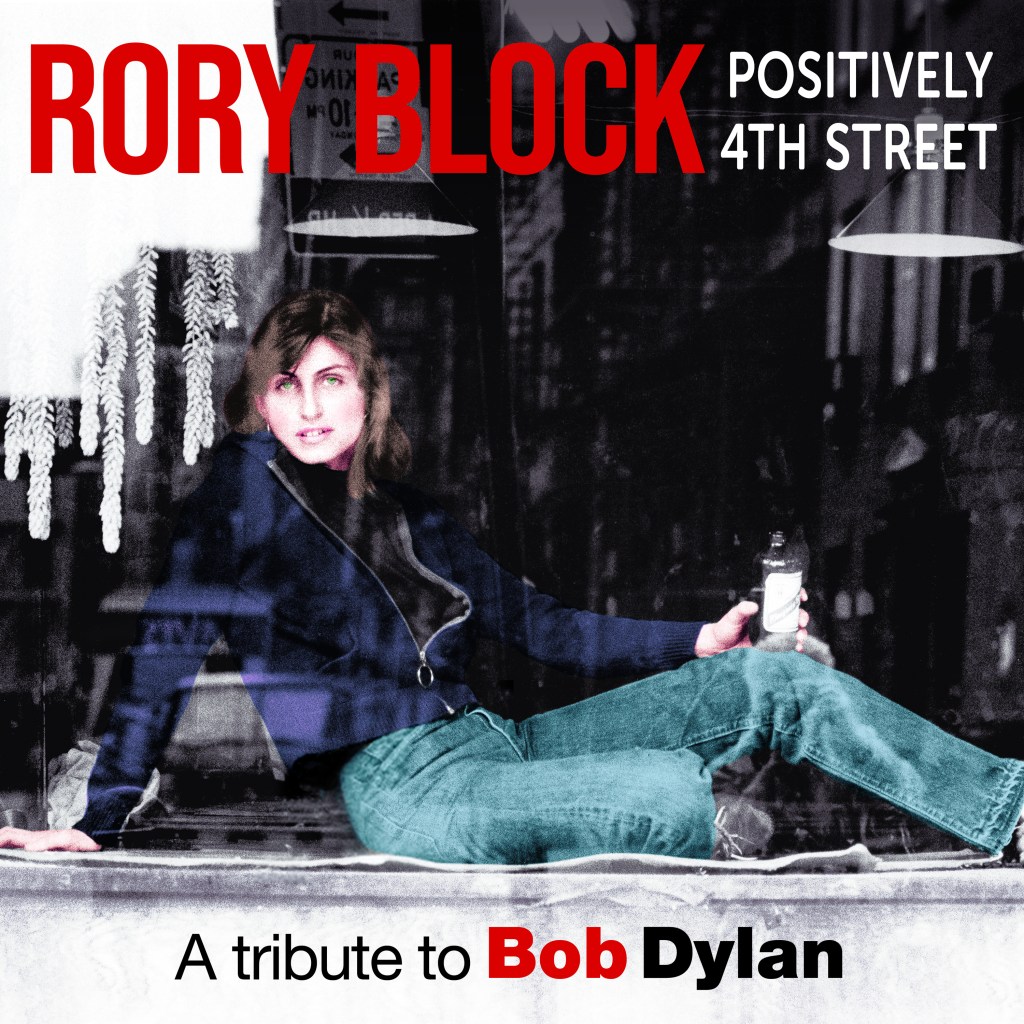
I put off writing about this album for a while. It’s not really blues, I thought, which is my primary focus. It’s just another tribute album, I thought — wrongly, as it turns out. But then, Rory Block is the premier acoustic interpreter of classic blues. And she’s singing Bob Dylan, who was nothing if not the poet laureate of his (and my) generation, and who was inspired by great American folk and blues music — Americana, if you like.
And then I listened again, and more closely. While this IS a tribute album — it says so right on the cover — it’s a damn fine tribute by an artist as accomplished in her field as Dylan is in his. She is, after all, a seven-time Blues Music Award-winning artist, and even that doesn’t do justice to her prolific and masterful career.
But it’s much more than a just a tribute. It’s Rory Block doing what she does best: She’s absorbing the material and recreating it in her own image, with her own inimitable acoustic guitar style. And she has chosen songs that reflect the broad, deep scope of Dylan’s music, not just his greatest hits, or his songs that lean into the blues. Block says that she was choosing tunes that “touched her heart and soul.”
Those songs that moved her are: “Like A Rolling Stone,” “Positively 4th St.,” “A Hard Rain’s Gonna Fall,” “Everything Is Broken,” “Ring Them Bells.” “Not Dark Yet,” “Mother of Muses” and “Murder Most Foul.” They’re songs that span Dylan’s immense body of work, from his early years to his most recent album.
It’s fair to say Block’s vision of Dylan has been informed by their shared environment: Block grew up in Greenwich Village during the early 1960s, where her father was a country fiddle player and owner of a sandal shop just a few doors from where Dylan lived, and her mother was a folk singer. Dylan was still a hopeful young folk singer, and a younger Block was just growing into her teens, absorbing the musical energy of the local musicians who would gather in her dad’s shop.
Here’s how Block describes some of that era in the liner notes:
“To me, Bob Dylan seemed almost like family—a brilliant brother who made it to the top. In the cover photo, taken in the late 1960’s, I am seated in the window of the Allan Block Sandal Shop, 171West 4th Street. The reflection in the glass is a reverse image of Jones Street, where Bob Dylan and Suze Rotolo were photographed for the cover of “The Freewheelin’ Bob Dylan.” They were walking down the middle of the street directly towards the front of the sandal shop….” The photo, she notes, is by the gifted folk and rock photographer David Gahr.
Block’s interpretations here are acoustic and precisely spare, with none of the full band impact of most of the originals. But that spareness, and her unique guitar virtuosity, serves to accentuate her strong vocals, which always lend passion and power to her work. That quality serves her well here, since Dylan’s work has always seemed to be his attempt to find music that matched the power of his magical lyrical imagery.
Block opens with a gritty vocal turn on “Everything is Broken,” a sly Dylan rocker from his 1989 album “Oh Mercy.” It’s lyrically sassy and musically swinging. “Ring Them Bells” comes from the same album, more of a hymn-like dirge that Block leans into with an elegant passion.
The classic “Like A Rolling Stone” follows, a 1965 single that helped Dylan define himself. Its tangled up in blue history is worth a digression here, so bear with me for a few paragraphs, and a little Dylanology here and there (It’s my blog, after all!).
Dylan talked about the song in a 1966 Playboy interview:
“Last spring, I guess I was going to quit singing. I was very drained, and the way things were going, it was a very draggy situation … But ‘Like a Rolling Stone’ changed it all. I mean it was something that I myself could dig. It’s very tiring having other people tell you how much they dig you if you yourself don’t dig you.”
Dylan described the song’s origins to journalist Jules Siegel, thusly:
“It was ten pages long. It wasn’t called anything, just a rhythm thing on paper all about my steady hatred directed at some point that was honest. In the end it wasn’t hatred, it was telling someone something they didn’t know, telling them they were lucky. Revenge, that’s a better word. I had never thought of it as a song, until one day I was at the piano, and on the paper it was singing, “How does it feel?” in a slow-motion pace, in the utmost of slow motion following something.”
The complete recording sessions that produced “Like a Rolling Stone”, including all 20 takes and the individual “stems” that comprise the four-track master, were released in 2015 on the 6-disc and 18-disc versions of “The Bootleg Series Vol. 12: The Cutting Edge 1965–1966.”
It was an epic song; an early masterpiece that helped define Dylan and his audience. Block engages “Rolling Stone” with heart and soul, and despite the lack of the album’s rock background and Al Kooper’s (improvised) rolling Hammond intro, she powers along with her rousing version.
Block gives a spare and haunting reading to the darkness of the ballad, “Not Dark Yet,” from 1997’s “Time Out of Mind,” featuring Cindy Cashdollar’s elegant baritone guitar solo (she’s the only artist besides Block to appear here). Block delivers a folksy vibe to the extremely well-covered and criminally popular “Mr. Tambourine Man,” from the acoustic side of his 1965 album “Bring It All Back Home.”
One of the best covers here is the title track. Block distills the rock treatment of “Positively 4th Street” into a stark vocal, not unlike Dylan’s, recorded in 1965 for the album “Highway 61 Revisited.” She follows that with another one of her best, and one of my favorite Dylan songs, “A Hard Rain’s A-Gonna Fall,” recorded in 1962 for his second studio album, “The Freewheelin” Bob Dylan in1963. It’s filled with the symbolic imagery that characterizes so much of Dylan’s great work.
“Mother of Muses” was an acoustic poem from the 2020 album, “Rough and Rowdy Ways,” and Block shifts from Dylan’s gruff rendering to a effective vocal in a higher register. The song offers a paean to Mnemosyne the goddess of memory in Greek mythology, who gave birth to the nine Muses, (the inspirational goddesses of literature, science and the arts). It’s a profound and reverential reading.
The closer is the epic “Murder Most Foul,” the final track on “Rough and Rowdy Ways.” It’s a musical adventure in imagery and wordplay that revolves around the assassination of President John F. Kennedy, with a multitude of political and cultural references. Block’s somber reading is stark and effective, despite her 20+ minute version of the original, a nearly 17-minute opus. In a statement released with the single, Dylan indicated that “Murder Most Foul” was a gift to fans for their support and loyalty over the years.
Rory Block has a uniquely powerful body of work in her own right. She’s the premier acoustic blues artist performing today. “Positively 4th Street” adds an impressive new dimension to her work, covering the premier singer-songwriter of our era. That musical combination demands your attention — and your appreciation.
Don Wilcock, writing in the American Blues Scene, has an insightful conversation with Rory Block about this album. Read it here.
“Ring Them Bells” from the album:
Tracklist:
01 – Everything Is Broken
02 – Ring Them Bells
03 – Like A Rolling Stone
04 – Not Dark Yet
05 – Hey Mr. Tambourine Man
06 – Positively 4th Street
07 – A Hard Rain’s A- Gonna Fall
08 – Mother of Muses
09 – Murder Most Foul
 Blues Roadhouse
Hi Jim,
It’s Dan Sumner (Doug Duffey and BADD). Here’s a link to our first video from AIN’T GOIN’ BACK. It’s a live version of the opening track, Whirlpool
LikeLike