Well, the Grammy nominees were announced today, and since I know you are all on the edge of your thoroughly disinfected seats awaiting the list, I thought I’d share the ten albums that earned Grammy’s attention in the blues category. Two categories, actually, traditional and contemporary.
Here they are, for your amusement or consideration:
Best Traditional Blues Album For albums containing at least 51% playing time of new vocal or instrumental traditional blues recordings.
ALL MY DUES ARE PAID Frank Bey
YOU MAKE ME FEEL Don Bryant
THAT’S WHAT I HEARD Robert Cray Band
CYPRESS GROVE Jimmy “Duck” Holmes
RAWER THAN RAW Bobby Rush
Best Contemporary Blues Album For albums containing at least 51% playing time of new vocal or instrumental contemporary blues recordings.
HAVE YOU LOST YOUR MIND YET? Fantastic Negrito
LIVE AT THE PARAMOUNT Ruthie Foster Big Band
THE JUICE G. Love
BLACKBIRDS Bettye LaVette
UP AND ROLLING North Mississippi Allstars
And if you have broader interests, here is a link to every Grammy nominee in all of the 83 categories.
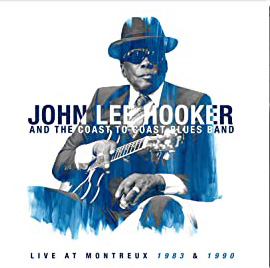
Just recently, I noticed a new release of John Lee Hooker music, a double vinyl album titled “Live at Montreux – 1983 & 1990,” on Eagle Records.
I might not have mentioned it, since it’s a double album in vinyl, but I know that more and more music is being released in this great old format for its sound quality, and also so you can have those nice big album covers to hang on the wall for artwork. Like we did in the ’60s. With beads.
This is a live album (I know, that should be obvious), and as far as I can tell, not yet streaming. On the other hand, the music has been previously released on two earlier, separate albums, which are streaming, at least on Amazon Music. So what’s new here is the double set, the vinyl, and a pair of video packages for each concert.
If you’ve ever paid any attention to the blues, and maybe if you haven’t, you’ve heard of John Lee Hooker, one of the all-time greats. He left the Mississippi Delta when he was 14, apparently never looked back, and after performing a while in Memphis, moved around until he settled in Detroit, and was working as a janitor in a steel mill when he recorded “Boogie Chillen” in 1948.
He wrote and recorded prolifically, and like many bluesmen of his era, recorded under different names to avoid label contract problems while trying to earn more money. He sometimes recorded under the names John Lee Booker, Johnny Lee, John Lee, John Lee Cooker, Texas Slim, Delta John, Birmingham Sam and his Magic Guitar, Johnny Williams, and the Boogie Man.
His music was unusual — he often played with his own beat and tempo, making changes to suit the song, or maybe even his mood. It was sometimes repetitive, often hypnotic. Plus, he always looked really sharp. Usually with a fine fedora.
Another reason for wanting to write about this new release is that I’ve been looking for a chance to show off some of my blues photography. I don’t come anywhere close to the massive and creative body of work of my favorite blues boxman, Joe Rosen, but I do have a few things that I like, and which generate fond memories.
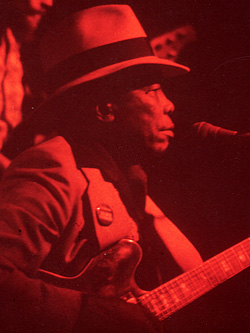
Jim White photo
This Hooker photo is one of them. It was taken around 1980, in a club called Mancini’s Lounge, in the town of McKees Rocks, just outside Pittsburgh, where the blues flourished for a few years.
Hooker was starting his set, and as fans kept coming up to the stage and popping their flash cameras in his face (yes, Virginia, there was a time before cell phones existed), he quickly grew annoyed. So he told everyone to cut it out, or he would cut out – no more Hooker.
Well, I was standing around with my camera and long lens, and I didn’t usually use a flash anyway, but I didn’t want my big lens to scare him away. But I did want a photo. So I hid behind one of the speaker towers at the side of the stage, poked my lens around the front, and snapped off a few pics with the stage light available. Which happened to be red. And this red profile is the result.
It’s a decent photo, but it brings back great memories as well.
Hooker’s blues are unique and memorable, but one song I find among the most memorable is his duet recording of “I’m in the Mood” with Bonnie Raitt for the 1989 album, “The Healer.”
It’s about as sexy and sensual as the blues gets, and as much fun as it is to listen to, here’s a video that gives you a good idea of the interplay. Raitt has described the 1989 recording as “one of the highest erotic experiences of my life.”
Here are the tracks on the new double album:
1983 – LP 1 SIDE A 1. “It Serves Me Right To Suffer” 2. “I Didn’t Know” 3. “Hi-Heel Sneakers” 4. “If You Take Care Of Me, I’ll Take Care Of You” 5. “Boom Boom”
SIDE B 1. “Worried Life Blues” 2. “I’m Jealous” 3. “Crawlin’ King Snake” 4. “Boogie Chillen’”
1990 – LP 2 SIDE A 1. John Lee Hooker Introduction 2. “Mabel” 3. “I’m In The Mood” 4. “Crawlin’ King Snake” 5. “Baby Lee”
SIDE B 1. “It Serves Me Right To Suffer” 2. “Boom Boom“ 3. “The Healer” 4. “Boogie Chillen’”
Here are a few recent albums I’ve noticed that seem worthy of some attention.
Kim Wilson — “Take Me Back – The BigTone Sessions” M.C. Records
Wilson has been the lead singer and harp man for The Fabulous Thunderbirds for about 30 years now, but sometimes steps out on his own, This album is a nice throwback to a more traditional blues framework than the T-Birds often provide (not that the T-Birds aren’t still tuff enuff). This is more of a deep-blue, down-home album, with music steeped in the bubbling cauldron of Chicago blues. The harp work is fine and the vocals tough, and the old-fashioned mono and “live” recording need only a whiskey chaser to feel more authentic.
Chris Smither — “More from the Levee” Signature Sounds
Chris Smither may not be your idea of the typical bluesman, but his 50 years of writing, recording and performing his very personal brand of introspective music have always seemed to be well-informed by the blues. This album picks up where his 2014 retrospective “Still on the Levee” left off, with tracks that missed out on the earlier sides. It’s. is always worth a listen to see what Chris has to say about our world. This is an excellent example.
Here’s one of the tracks:
And here’s a video of Chris performing his now-classic “Love You Like a Man,” which people seem to associate more with Bonnie Raitt, who made it a big hit. She, of course, reversed the gender roles, and the song became “Love Me Like a Man.” I have no objection to that, but I have always been a little miffed because Bonnie also decided to change the first line of the song from: “These men you’ve been seeing got their balls up on the shelf….” To the somewhat more ethereal: “Men that I’ve been seeing, baby, got their soul up on a shelf… “
Brother guitar duos are a rare and special commodity in the music world, with such a bond resulting in historic acts like AC/DC, The Kinks, CCR, The Everly Brothers and Stevie Ray and Jimmie Vaughan. Ventura County brothers Tommy and Paddy Marsh formed Crooked Eye Tommy in 2010, becoming six-time Ventura County Music Award winners and two-time International Blues Challenge semi-finalists (2014 and 2019) and in 2020 reached the IBC finals as a duo act.
Their new album (just their second), “Hot Coffee and Pain,” is a tasty blend of blues, rock and roots tracks, including six originals. Their style ranges from a high-intensity version of Son House’s “Death Letter Blues” on the opening track, to the soulfully sensual “Baby Where You Been,” a duet written by Tommy Marsh that features Teresa James on piano and vocals. These very talented and creative brothers deserve a listen.
More blues history from the vault — or at least from the depths of the world wide web.
Maybe this is newer to me than to some of you, but I thought it was still a striking pair of performances. The film is from an old TV show devoted to the arts called Camera Three, which ran from 1956 to 1980 on CBS and then PBS. This clip is one of the CBS episodes.
In some ways, 1968 doesn’t sound all that long ago. But on the other hand, some of you might not have been born yet. Or, looked at another way, more than a half-century ago. Or, on yet another hand, it was just one year after the Summer of Love. I know you remember that!
The show features a segment by Son House, then 66, and a set by Buddy Guy, then 32. Then, the best moments, a duet between the two — an all-too-brief pairing.
I know there are a lot of fans out there who love the music of one of the latest young new blues stars — Christone “Kingfish” Ingram. He’s just 21, and already received a bunch of awards for his slashing guitar and authentic style. I saw him on the LRBC in February of last year. Everything you hear about him is true!
So, for those of you may have missed the segment that NPR devoted to him last night, here it is — just another public service from the Blues Roadhouse.
The rich history of the blues is what helps to make it a compelling musical form. Getting in touch with that rich history is another matter.
There are grainy films and images, and scratchy recordings of some of the artists from the early years of the 1900s who introduced the music to wider audiences, beyond the house parties and juke joints where the primeval music bubbled from its origins into the national consciousness.
And there were enough revivals and rediscoveries of old-timers in the 1950s and ’60s to offer a tantalizing picture of early blues — Mississippi John Hurt, Fred McDowell, Sleepy John Estes, Sippie Wallace, Son House and Alberta Hunter, to name a few.
And just a handful of writers and researchers were trying to document the music in a serious way. One of those hardy individuals was Sam Charters, (don’t overlook his biography here, he was born in Pittsburgh and musically talented at an early age) a writer, music historian, record producer, and a widely published author on blues and jazz.
Charters would write “The Country Blues,” a seminal book of blues history, in 1959, which was accompanied by a Folkways album of the same name. The album was filled with songs that illustrated the music described in the book.
As his love of and interest in the blues developed, one of the things that Charters wanted to do was document the blues, not necessarily as a commercial product, but as a profound expression of human lives. To do that, he wanted to find and film some of the people who were performing the music where they lived.
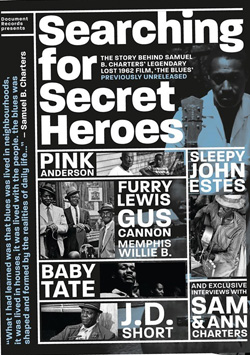
“Searching for Secret Heroes” is the story of how Charters and his wife Ann toured the South to gather material for this earliest of blues documentaries, filmed in 1962, but never really released commercially, and thought to be lost. The film was titled simply, “The Blues.” An album of music from the film had been released, and is part of this new release package.
The 26-page booklet that accompanies this historic DVD/CD set tells the fascinating story of how Charters and Gary Atkinson, the owner of Document Records in Scotland, a small but prolific producer of vintage blues, jazz and more, met by accident in 2013. The result was this film.
The film itself is a brief, but very powerful journey into the lives of its musicians, which Charters found was tortuously bound to the oppressive and racist conditions under which they lived.
The bulk of the DVD is a compelling interview with Charters and his wife Ann, a writer and photographer who helped produce the documentary, in which they talk about how it came about, the many tasks of filming, and their being overwhelmed by the living conditions of these musicians. Don’t ignore this part — it’s as important as the music itself.
I don’t usually do this, but I think it’s worthwhile to link to the page where you can order the package. That’s how I got mine. I’m not sure that it’s widely available, and I think it’s worth considering if you’re interested in this type of blues history.
Here’s a trailer for the package from Document Records:
A few blues notes that keep floating around my troubled mind:
Goodbye Jimmy Reed The new Bob Dylan album, “Rough and Rowdy Ways,” is not really a blues album, but a lot of Dylan’s work has been inspired by and infused with the blues. I think it’s an excellent album, a showcase for Dylan’s still-sharp word and image play. But I have to confess that my favorite cut on the album is the pounding, bluesy, “Goodbye Jimmy Reed.” I also think it’s one of the best on the album, as Dylan releases his playful inner wordsmith, full of crisp imagery and snarling musicality. Alas, there seems to be no video version, but here’s the song in its finest audio, the way music was meant to be heard! And Jimmy Reed is still one of the best.
Do Klingons get the blues? I’m a little late with this one, but you’ve probably already added this new release to your collection, since it goes where where not much blues has gone before. I’m talking, of course, about William Shatner’s latest album (yes, he’s recorded a bunch), of blues songs. It’s called “The Blues,” and it’s another of Shatner’s spoken word albums. Well, Shatner is 89, and it’s about time he got around to America’s classical music, but it’s not exactly out of this world. He did get himself a good backing band and guest artists, though. But somebody, please, just beam him up.
Defining the blues Every once in a while, over the years, someone would ask me to define the blues. I always stumbled around for an answer, and then I stumbled upon a definition that finally satisfied me. It’s by author Giles Oakley, and from the foreword of the second edition of his book, “The Devil’s Music: A History of the Blues.” It reads: “To some extent the blues negotiate the tensions between opposition to the status quo, accommodation to it, and transcendence of it through the joy of sensual release.” Yes, what he said.
Sam Chatmon Speaking of the history of the blues (I hope you paid attention to the last item), I’m a big fan of blues history, and historical blues figures. That’s why I was happy to find recently a video from 1978 of one of the earliest Delta blues players (although in those days they often played from a wide and varied repertoire). It’s Sam Chatmon, born Vivian Chatmon in 1897, a solo performer, and then well known as a member of the Mississippi Sheiks. He outlived many of his contemporaries, and recorded again in the folk-blues era of the 1960s and ‘70s. Here’s a sample.
Whilst cruising the world wide webs recently, I checked out a site that I occasionally use to find unusual things — it’s called Open Culture.
It’s a fun site, with lots of free stuff. Books, movies, music and much more. I highly recommend it for your amusement and enlightenment — and if you’re anything like me, you can use some of each right now.
I plugged in a search for “blues,” and was rewarded with many interesting results, but one in particular caught my eye.
That was a book that I just happened to have reviewed in 2004. I can recommend the book much more highly than the review, but both are here for your indulgence.
If many of you are sort of like me, and find yourselves hooked on the marvelous musical adventure that is the Legendary Rhythm & Blues Cruise, you’re probably beginning to miss them even more now that it’s about time for the cancelled October cruise.
If you’re a cruiser, you have probably already seen the following information on the cruise Facebook page. But, as a public service, the Blues Roadhouse is happy to repeat the plans for a landlocked cruise, starting Sunday, Oct. 25. If you’ve never been a cruiser, check out this modified lineup and get a taste of what you’re missing.
Here’s the LRBC announcement:
The musicians of the world, along with the live venues, the service and travel & tourism industries, and so many millions of others have had their lives turned upside down since March 13, 2020. Originally scheduled to sail out of Port Everglades this Sunday on the Holland America Eurodam, we have now reset LRBC #35 for October 24-31, 2021 and can’t wait to be back at sea together!
To stay connected with our cruiser family, we’ve teamed up with our fantastic musicians to present: Dry Docked & Landlocked – a Virtual Cruise for the coming week, October 25-31, starting @ 5:00pm CST Daily via LRBC Facebook Live and LRBC Youtube. We have also partnered with Can’t Stop the Blues, who will re-broadcast our virtual cruise daily at @ 9:00pm EST.
We have reached out to the musicians and staff across the globe who will be sharing greetings and well wishes from their homes. We will be featuring videos throughout the week of their living room performances, previous LRBC performances, and various activities onboard the cruises.
Day 1, Sunday 10/25 Theme: Hometown Blues Sail Away Delay Party w/ Danielle Nicole Band Virgin Party w/ RUF Records Blues Caravan w/ Jeremiah Johnson, Ryan Perry & Whitney Shay Returnee Party w/ Surprise Guests Elvin Bishop w/ Mickey Thomas & Charlie Musselwhite Mitch Woods
Day 2, Monday 10/26 Theme: Soul Blues & Give Me Back My Wig!! Gospel Brunch w/ Mr. Sipp Johnny Rawls Shemekia Copeland w/ Ronnie Baker Brooks Keb’ Mo’ Kelley Hunt
Day 3, Tuesday 10/27 Theme: Carnival Dom Flemons Reverend Peyton’s Big Damn Band Taj Mahal & Phantom Blues Band Rev. Billy. C. Wirtz w/ Barry Cuda & Mick Kilgos Cherry Sea Breeze Drink Demo w/ Tom Burns
Day 4, Wednesday 10/28 Theme: Pirates Hadden Sayers Surprise Guest Terrance Simien Culinary Kenny Neal Walter Trout Eden Brent
Day 5, Thursday 10/29 Theme: Legendary Gear Driftin’ & Driftin’ w/ G. Love & Rev. Billy C. Wirtz Vanessa Collier Charlie Musselwhite Lola Sunrise Party
Day 6, Friday 10/30 Theme: Legendary Sea Creatures Shakura S’Aida Doug MacLeod Phantom Blues Band Ruthie Foster Mitch Woods Club 88 Highlights
Day 7, Saturday 10/31 Theme: Halloween Marquise Knox Tommy Castro Tab Benoit Rev. Billy C. Wirtz Monster Mash Martini Drink Demo w/ Tom Burns
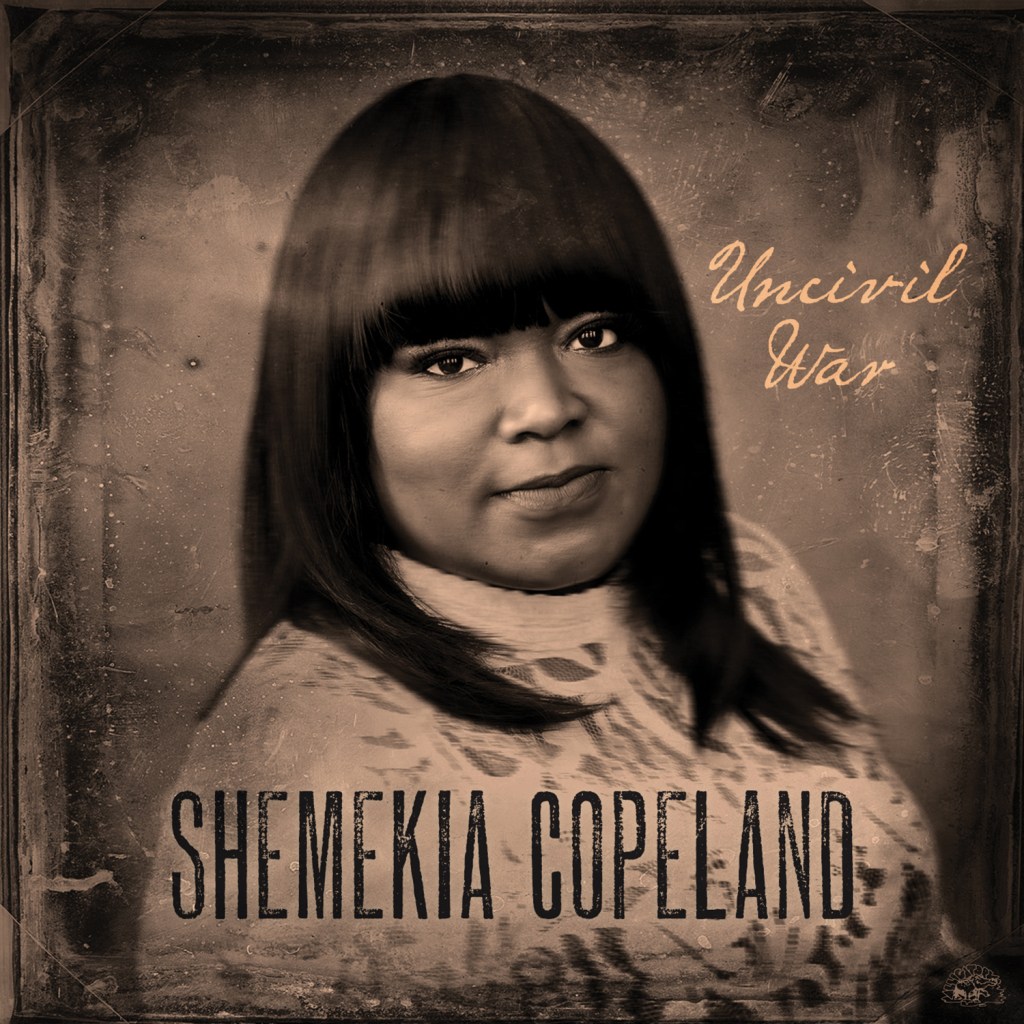
When Shemekia Copeland recorded her first album, “Turn the Heat Up” in 1998, she was just 18, and it was clear that her powerful vocals would make her a force to be reckoned with in the blues world.
Since then, she has established herself firmly atop the ranks of contemporary blues singers, and she has indeed become that force across multiple genres.
Now, with “Uncivil War,” her tenth album, due out Oct. 23, Copeland has taken a step beyond her blues boundaries, to make her music sing of social and political upheaval.
The album’s centerpoint and opening track is “Clotilda’s On Fire,’ a fierce and historic blues, telling the story of the slave ship Clotilda, the last one to come to America, delivering its human cargo in 1859. It was 50 years after the slave trade was banned, but illegally continued. The ship was burned and sunk in Mobile Bay, Ala., and the wreck discovered in May, 2019.
Copeland’s telling of the story in song is passionate and powerful. Intense guitar work by Jason Isbell adds its own stinging dimension. It’s a moving experience.
That song is quickly followed by “Walk Until I Ride,” a gospel-like anthem of social protest, and then the title track, asking “why can’t we all just get along”?
The rest of the songs unfold in a variety of styles and contexts, all fueled by Copeland’s blues roots, and may with a point to make. The uptempo “Money Makes You Ugly” is one of those, with the point right there in the title.
“Apple Pie and a .45” shoots out its own anti-gun message, and “She Don’t Wear Pink” rocks with gender equality.
And there are a few just-plain-musical messages, including “Dirty Saint, a tribute to her friend and “Talking to Strangers” album producer Dr. John (Mac Rebennack). Her take on the Rolling Stones’ “Under My Thumb” is a tough musical role reversal, with the guy under her thumb. “No Heart At All” tackles a more traditional blues theme seen through Copeland’s eyes.
On “Give God the Blues,” the idea that “we all give God the blues” adds another look at how we just might be messing up our own lives.
And in a perfect final cut, Copeland sings the gorgeous blues ballad “Love Song,” written by her late father, bluesman Johnny Clyde Copeland. Producer Will Kimbrough aces the guitar solo.
The production values here help take this album to a new level. Kimbrough, plays guitar and wrote or co-wrote six of the twelve tracks. You can also listen for guests, the already mentioned Jason Isbell, legend Steve Cropper, the very up-and-coming guitarist Christone “Kingfish” Ingram, rocker Webb Wilder, the great Duane Eddy, Sam Bush on mandolin, dobro master Jerry Douglason dobro.and The Orphan Brigade providing background vocals.
This is a great album, filled with Copeland’s strong vocals, excellent musical craftsmanship, and a social conscience. Ultimately, it’s a plea for peace, love and hope.
 Blues Roadhouse